Answering common questions about small-tank filtration, these air-driven sponge filters are ideal for nano tanks, fry rooms, and hatcheries. They provide mechanical and biological filtration with gentle water flow, increasing oxygenation without stressing delicate inhabitants. This guide highlights five top options, who they’re best for, and practical buying considerations.
Quick reference table of selected products:
| Product | Best For | Notes |
|---|---|---|
| AQUANEAT Aquarium Air Driven Corner Sponge Filter (Small) | Very small fry and nano tanks | Corner design; minimal current |
| Pawfly 3 Pack Aquarium Sponge Filter | Multiple small tanks; breeding setups | Three filters; compact size |
| myfole Mini Aquarium Filter Air Driven Sponge Filter | 0.5–5 gallon tanks | Saves space; easy to clean |
| hygger Aquarium Sponge Filter | Low-flow breeding, bettas, shrimp | Biochemical ball included |
| AQUANEAT Sponge Filter for Fry Tanks (Corner) | Fry and nano tanks needing gentle flow | Multi-layer design for cleaning |
AQUANEAT Aquarium Air Driven Corner Sponge Filter (Small)

Best for ultra-small tanks and hatcheries, this corner filter provides mechanical and bio filtration while delivering oxygen to the water. It runs with low wattage and reduces pump noise. Setup is straightforward: attach an airline and power the air pump, then rinse the sponge in tank water before use. It’s safe for small fish like dwarf cichlids, guppies, and fry tanks, as it minimizes current and the risk of sucking fish into the filter.
- Best for: tiny tanks or maternity tanks where gentle flow matters.
- Why chosen: compact corner design saves space and offers bio filtration in a small footprint.
- Limitations: not ideal for larger tanks or high-flow setups.
Pawfly 3 Pack Aquarium Sponge Filter

The three-pack provides mechanical and bio filtration in compact 2″ D x 4.8″ H units. They fit 5–10 gallon tanks well and are suitable for breeding and feeding fish, shrimp, or fry. Easy detachment for cleaning helps maintain water clarity. A caution: clean with tank water only to preserve beneficial bacteria; avoid tap water that can kill beneficial cultures.
- Best for: owners with multiple small tanks or backup filters.
- Why chosen: value-packed, small footprint, easy maintenance.
- Limitations: the trio may be undersized for larger setups or very active fish.
myfole Mini Aquarium Filter Air Driven Sponge Filter

Designed for 0.5–5 gallon tanks, this air-driven filter is ultracompact and easy to clean. It promotes oxygenation by adding micro-bubbles while performing basic filtration. Best suited for tiny fry rooms or betta setups where preserving space is essential. Note: routine sponge washing should occur in tank water to preserve beneficial bacteria.
- Best for: very small tanks or fry boxes where space is at a premium.
- Why chosen: strong space efficiency and straightforward maintenance.
- Limitations: limited flow may not meet higher filtration demands in larger tanks.
hygger Aquarium Sponge Filter

hygger’s sponge filter features both circular bio cotton and a filtration chamber with bio ceramic balls, delivering mechanical and biological filtration. The design supports low-flow breeding scenarios for bettas, guppies, shrimp, snails, and fry, and can also function as a pre-filter for other systems. It includes a built-in bubble stone to increase dissolved oxygen. Best for: breeders and small tanks seeking robust biological filtration.
- Best for: low-flow breeding setups and oxygenation needs.
- Why chosen: dual-stage filtration and oxygenation features enhance water quality.
- Limitations: may be larger than ultra-tiny tanks; ensure adequate space.
AQUANEAT Sponge Filter for Fry Tanks (Corner)

Specifically aimed at fry and nano tanks, this corner filter provides mechanical and biological filtration with an oxygen-rich infusion chamber. It reduces pump noise and wattage while offering a multi-layer cleaning design. It’s safe for small fish and hatchery settings because it minimizes current and avoids drawing fry into the filter.
- Best for: fry rooms, maternity tanks, and nano setups.
- Why chosen: optimized for delicate fry with gentle water flow.
- Limitations: corner placement may be less convenient in some layouts.
Pawfly Aquarium Air Pump with Nano Bio Sponge Filter Kit
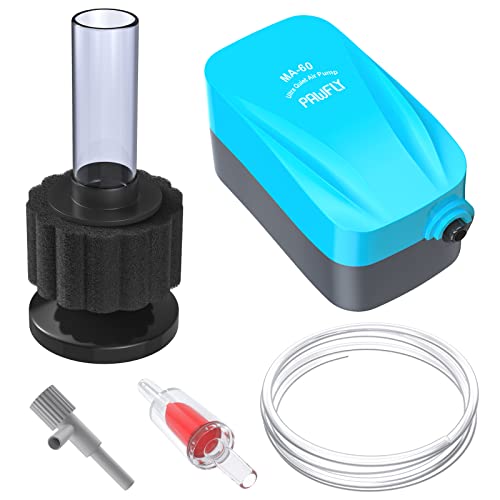
This kit combines a 40 GPH air pump with a 1.5″ D x 3″ H sponge filter, increasing oxygen content through dense bubbles and trapping impurities. The included air control valve lets you adjust flow, and the compact pump suits 3–10 gallon tanks. Best for: users who want adjustable airflow in a small package.
- Best for: adjustable filtration in small tanks with modest stocking.
- Why chosen: controllable oxygenation and compact design.
- Limitations: require a separate air pump and tubing.
Buying Guide: Key Considerations for Air Driven Sponge Filters
- Tank size and stocking: Choose filters sized for 0.5–5 gallons for fry rooms; larger filters support up to 20 gallons with adequate flow.
- Flow and oxygenation: Air-driven designs boost oxygen through bubbles; consider filters with bubble stones or multi-layer filtration if oxygenation is a priority.
- Filtration balance: Look for devices offering both mechanical and biological filtration with sponge and bio media for complete cleaning.
- Maintenance and cleaning: Select filters you can detach easily and rinse in tank water to preserve beneficial bacteria.
- Noise and energy use: Corner models and low-wattage units minimize noise and power consumption in quiet rooms or bedrooms.
- Fish compatibility: For small or delicate fish (dwarf cichlids, endlers, fry), opt for filters designed to deliver gentle currents.
Frequently Asked Questions
- Q: Are air driven sponge filters good for shrimp tanks? A: Yes, they provide gentle filtration that protects small shrimp and fry while promoting water quality.
- Q: How often should the sponge be cleaned? A: Typically every 2–4 weeks, using tank water to avoid disrupting beneficial bacteria.
- Q: Can these filters replace a canister or hang-on filter? A: They work best for small tanks or as pre-filters; for larger setups, consider additional or higher-flow filtration.
- Q: Do these filters require pressurized air? A: Yes, they rely on an air pump to drive water through the sponge and create current.
- Q: Are corner sponge filters suitable for fry tanks? A: Yes, their low current design is generally safer for fry and juvenile fish.
- Q: Can I use these in betta tanks? A: Some models are suitable if the flow is gentle; avoid strong currents that stress bettas.