Direct answer: for reliable aquarium aeration, choose compact, quiet pumps with adjustable output and dual outlets to oxygenate tanks up to 100 gallons. This guide highlights five top options, explaining who they’re best for and why they suit different setups—from small betta tanks to large community aquariums.
The following table summarizes the five recommended products, focusing on compatibility, airflow, noise level, and best-use scenarios.
| Product | ||||
|---|---|---|---|---|
| Uniclife 64 GPH Aquarium Air Pump | Medium tanks, dual outlets | 64 | Low to moderate | 10-100 gallons |
| HITOP Dual Outlet Quiet Air Pump | Medium to large tanks needing adjustable flow | Up to 110 | Quiet | 20-200 gallons |
| Pawfly 50 GPH Dual Outlet | Space-conscious setups | 50 | Very quiet | Up to 60 gallons |
| AQQA Stainless Steel Dual Outlet Pump | Larger tanks or hydroponics | Up to 100 | Low noise | Up to 200 gallons |
| AQUANEAT 100gal Dual-Outlet Air Pump | Very large tanks, multiple air stones | Up to 100 | Quiet | Up to 100 gallons |
Uniclife 64 GPH Aquarium Air Pump
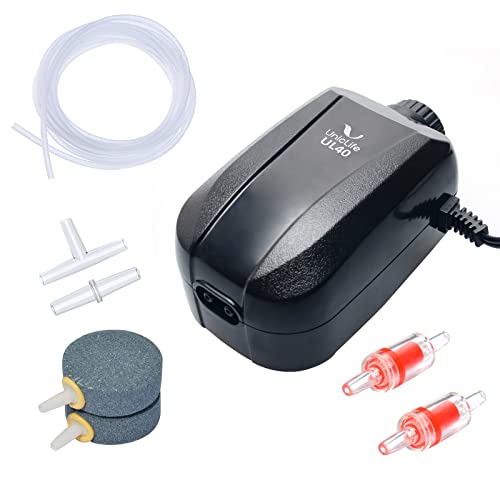
Best for: aquarists with 10–100 gallon tanks seeking reliable dual outlets and adjustable airflow. This pump delivers up to 64 GPH with a rotary control to fine-tune oxygenation. It includes an air stone, tubing, and connector accessories for immediate setup.
Why chosen: The dual outlets allow simultaneous aeration of multiple zones or decorations, helping maintain uniform oxygen levels. The 4 W motor balances power with quiet operation, making it suitable for bedrooms or living spaces.
Limitations: Air output can drop if intake cotton becomes clogged; replace the intake cotton to restore performance. Sound levels vary with airflow, with higher settings producing more noticeable hum.
HITOP Dual Outlet Aquarium Air Pump

Best for: aquariums from 20 to 100 gallons needing two outlets and adjustable air flow. This 3 W pump offers adjustable output and a shark-inspired design that doubles as a focal point while delivering steady aeration.
Why chosen: The two outlets support larger layouts or aeration devices like sponge filters alongside stones. Its multi-layer construction aims to minimize vibration and noise, promoting a calm home environment.
Caution: While designed for long life, ensure the outlets are kept free of blockage to prevent reduced airflow. The shark shell is decorative but should not impede air delivery when hoses are connected properly.
Pawfly Aquarium Air Pump 50 GPH

Best for: small to mid-sized tanks up to 60 gallons where energy efficiency is important. This unit provides a steady 50 GPH output with a top-mounted dial to adjust air flow and two outlets in some variants.
Why chosen: Low power consumption (1.25 W) and quiet operation (under 30 dB) make it suitable for dorm rooms or apartments. The top adjustment knob enables quick tuning as biological loads shift.
Limitation: Best used where space permits dual hoses; single-outlet configurations may limit placement flexibility in very tight setups.
AQUANEAT 100Gal Dual-Outlet Air Pump

Best for: larger aquariums reaching up to 100 gallons and setups requiring multiple aeration devices. The dual-outlet design supports running multiple air stones or sponge filters from one pump.
Why chosen: The compact footprint with dual outlets provides greater aeration flexibility in bigger tanks, improving surface agitation and dissolved oxygen distribution. Rubber feet reduce vibration for quieter operation.
Limitation: At higher airflow, some component surfaces may become warm; ensure adequate clearance for heat dissipation and check airflow periodically.
Buying Guide: Key Considerations For Choosing The Right Air Pump
- Tank size and layout: Select a pump that matches your tank volume (e.g., 10–60 gallons for Pawfly 50 GPH, up to 100 gallons for AQUANEAT 100G). Dual outlets help distribute air evenly in larger setups.
- Airflow and adjustability: Pumps with adjustable output let you tailor aeration to fish stocking, plant load, and water movement needs. Higher airflow suits bigger tanks but may increase noise.
- Noise and vibration: Look for units with rubber feet, multi-layer enclosures, or compact designs to minimize noise. Two-layer builds reduce resonance, especially in quiet rooms.
- Power efficiency: Units with low wattage (1–4 W typical) reduce running costs and heat generation over time, ideal for dorms and apartments.
- Durability and materials: Stainless steel or reinforced housings can improve life expectancy in humid aquarium environments. Ensure hoses and stones are included or compatible if you plan to upgrade.
- Maintenance: Choose models with accessible intake components and straightforward maintenance routines to prevent blockages that reduce air flow.
- Compatibility with accessories: If you plan to use air stones, check that the pump includes connectors or that compatible tubing is readily available.
- Placement and aesthetics: Some designs, like the shark-shaped HITOP, offer a decorative addition while staying functional; consider how the pump fits with your tank’s decor.
Frequently Asked Questions
- What size air pump do I need for a 20-gallon tank?
– Look for pumps rated for 20–30 gallons with 30–40 GPH airflow for gentle aeration, or higher if you run multiple stones. - Do dual-outlet pumps improve oxygenation more than single-outlet ones?
– Yes, dual outlets can distribute air more evenly and support multiple devices, improving oxygen exchange in larger tanks. - Is it okay to run an air pump continuously?
– Continuous operation is common for aeration, but regular maintenance is important to prevent blockages and ensure consistent performance. - Are quieter pumps less powerful?
– Not necessarily. Quiet pumps often have efficient designs and damping features; always match airflow needs to tank size. - Can air pumps be used for hydroponics as well as aquariums?
– Many are suitable for small hydroponic setups, but confirm the maximum airflow and compatibility with hydroton stones or other media.