Find the right air blower for your aquarium with confidence. This guide highlights five top options that balance airflow, noise, and reliability for different tank sizes and setups. Best for beginners: compact, low-noise units that work well in small tanks. Best for larger setups: high-output pumps with multiple outlets. Each product includes clear reasons to choose it and potential drawbacks to consider.
Summary table of selected products:
| Product | Best For | Key Feature |
|---|---|---|
| Uniclife 64 GPH Aquarium Air Pump | Small to mid-size tanks (10-100 gal) | Dual outlets, adjustable flow |
| Pawfly Aquarium Air Pump 50 GPH | Budget setups up to 60 gal | Very low power usage, quiet |
| HITOP Dual Outlet Aquarium Air Pump | Quiet, reliable aeration | Two outlets, adjustable flow |
| AQUANEAT Aquarium Air Pump 300GPH | Medium to large tanks, multiple devices | High total output, adjustable flow |
| AquaMiracle 18W/600GPH | Higher-demand setups | High pressure, aluminum housing |
Uniclife 64 GPH Aquarium Air Pump
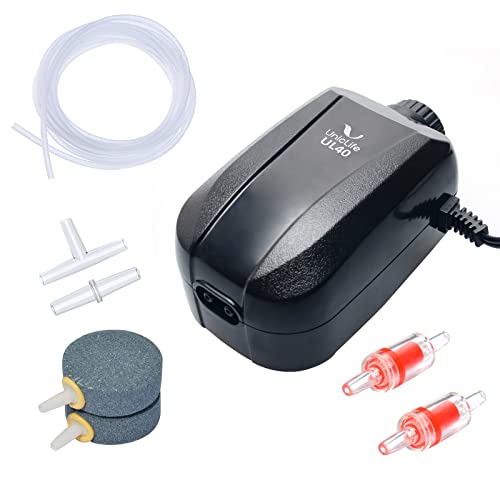
Best for small to mid-size tanks, this Uniclife pump offers dual outlets and adjustable airflow. With a maximum output of 64 GPH and a low power draw of 4 W, it supports aeration for tanks from 10 to 100 gallons. The rotary control lets you tailor oxygenation for fish, plants, or bottom-dwelling species. The unit operates quietly, rated around 25 dB on low and up to 45 dB at higher flow, making it suitable for bedrooms or offices. A potential caveat is that air output can drop if intake cotton becomes blocked, so regular maintenance is advised. Suitable for freshwater and marine setups that require steady but moderate airflow.
- Best for dual-output flexibility in mid-sized tanks.
- Fine for all-day operation with modest energy use.
- Be mindful of intake filtration to prevent reduced air volume.
Pawfly Aquarium Air Pump 50 GPH

The Pawfly model is best for budget-minded aquarists with tanks up to about 60 gallons. It provides a steady 50 GPH output and uses only about 1.25 W, supporting low-energy, long-term use. An adjustable top knob lets you dial in air volume, which is helpful when balancing plant and fish needs. It includes a quiet operation profile thanks to rubber feet that dampen vibration, often yielding noise levels under 30 dB, akin to a quiet conversation. A limitation is that it may not deliver as much air for very large or heavily stocked systems.
- Best for small to medium tanks on a tight budget.
- Adjustable airflow allows basic customization.
- Not ideal for large or heavily aerated setups.
HITOP Dual Outlet Aquarium Air Pump

HITOP targets quiet, reliable aeration for 20–100 gallon tanks. It features two outlets and manual, adjustable air volume, with a focus on reducing vibration and noise. The enclosure uses ABS thickened engineering plastics for durability and smoother operation. This pump is suitable for multi-tank setups or larger single tanks needing more oxygenation. A potential limitation is that performance may vary with very high airflow due to environmental conditions; ensure it’s placed in a well-ventilated area away from heat sources.
- Best for two-outlet flexibility in mid-to-large tanks.
- Adjustable air volume supports variable needs.
- Place in ventilated spots to prevent heat buildup.
AQUANEAT Aquarium Air Pump 300GPH

AQUANEAT delivers high total output with 300 GPH across four outlets, making it a strong choice for larger tanks or for powering multiple sponge filters and air stones. The flow is adjustable via a control knob, allowing precise oxygenation. The unit is designed to operate quietly due to rubber feet that minimize vibration and stabilize the pump. Suitable for bigger freshwater or non-saline setups that require more robust aeration. A caveat is that higher output units may require more air tubing and space behind aquaria to accommodate wiring and noise dampening.
- Best for powerful aeration in medium-to-large tanks.
- Multi-outlet setup supports several devices at once.
- Some setups may need extra space for tubing and heat considerations.
AquaMiracle Aquarium Air Pump
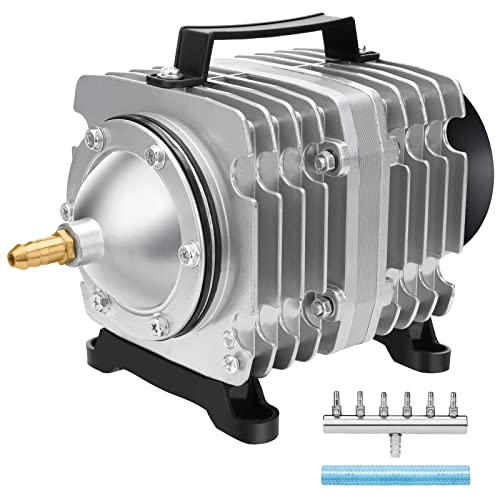
AquaMiracle brings a high-output option with a robust aluminum housing and a 18W motor delivering significant air pressure—600 GPH total. This model is designed for longevity and heat dissipation, making it well-suited for users who need higher performance in fairly large tanks or hydroponic setups. It’s best for aquariums or ponds where sustained airflow is necessary and ample ventilation is available. The main limitation is that higher power requires adequate electrical and environmental planning to prevent overheating in cramped spaces.
- Best for high-demand aeration and durability.
- Aluminum housing aids heat management.
- Ensure proper placement in well-ventilated areas to maximize life span.
Buying Guide: How To Choose The Right Aquarium Air Blower
What size is right for your tank?
Match the pump’s maximum airflow to your tank volume. Small tanks (10–20 gallons) benefit from 20–40 GPH units, while larger tanks often require 50–300+ GPH or multiple outlets to power filters and stones effectively.
How important is noise?
Look for models with rubber feet and soft housings for quieter operation. If you’re placing the pump near living spaces, prioritize units rated near or below 30–40 dB at typical flow.
Do you need multiple outlets?
Two outlets are useful for running several devices or separate aeration lines. If your setup only needs one bubble bar or air stone, a single-outlet pump may suffice and save space.
Is heat management a concern?
High-output pumps generate more heat. Aluminum housings or good ventilation help extend life. Place pumps in open spaces and avoid enclosed cabinets without airflow.
What about maintenance?
Regularly clean intake filters or cotton to prevent air restriction. Check hoses and tubing for wear or kinks. A simple, periodic check helps maintain consistent oxygen delivery.
Frequently Asked Questions
- What size air pump do I need for a 20-gallon tank? A pump delivering roughly 20–40 GPH is typically suitable, depending on the number of aeration devices you use.
- Are quieter pumps always better? Not necessarily; they are preferable for living spaces, but ensure the pump provides enough airflow for your tank’s needs.
- Can I run multiple air stones from one pump? Yes, if the pump has multiple outlets or you use a splitter, but consider total flow and pressure needed for all devices.
- How do I prevent overheating? Place pumps in well-ventilated areas and avoid enclosed cabinets. High-output models benefit from ambient cooling.
- Should I choose a metal housing? Aluminum or metal housings offer better heat dissipation and durability, especially for larger, high-demand setups.
- Is it okay to leave an air pump on all the time? Most aquarium pumps are designed for continuous operation, but periodic checks and maintenance extend life and ensure consistent performance.