Answering the strong need for reliable, evenly heated water, these 800-watt aquarium heaters are designed for large freshwater and saltwater tanks. They provide robust warming power, multiple protections, and digital controls to help keep aquarium inhabitants comfortable. The following picks are best for large tanks starting around 80 gallons and up, where stable temperatures matter most. Each product is evaluated for system safety, ease of use, and overall suitability for specific tank sizes and species.
| Product | Tank Range | Key Benefit | Best For |
|---|---|---|---|
| Hygger 800W Aquarium Heater (Digital LED Controller) | 80–220 gallons | Strong heating power with detailed LED controller and multiple protections | |
| SEAOURA 800W Aquarium Heater | 100–180 gallons | External intelligent controller and temperature probe for flexible placement | |
| MantaMaze 800W Heater | 20–300 gallons (varies by option) | Dual heating tubes and external digital controller with clear LED indicators | |
| Fishkeeper 800W Adjustable Submersible Heater | 40–220 gallons | PID-like electronic control with rapid, efficient heating and safety protections | |
| AQQA 800W Aquarium Heater | 80–230 gallons | Explosion-proof quartz glass and memory function after power loss |
Hygger 800W Aquarium Heater — Digital LED Controller

Product details indicate 800W heat output suitable for 80 to 220 gallon tanks. It features an intelligent leaving-water protection and an automatic cut-off at unsafe temperatures or when out of water. The digital controller allows temperature adjustments from 59℉ to 93℉ with ±1°F accuracy. Best for large, mixed-species tanks that require stable daily heat and a clear, in-tank or edge-mounted control display. The built-in alarms indicate high or low temperature, helping prevent overheating or under-heating. A practical caveat is the need to ensure proper immersion and following the size chart for wattage selection to avoid oversizing.
Who it’s best for: Aquarists managing large freshwater or saltwater tanks who want robust protection and an easy-to-read, edge-mounted controller.
Hygger 800W Heater — Alternate 800W Model

This variant maintains the same 800W power class and digital LED controller as other Hygger 800W units, designed for mid-to-large tanks. It emphasizes straightforward temperature control and reliable safety protections, including overheating and water-out safeguards. Choose this if you want consistent, precise heating with a familiar Hygger design language in a large-tank setting. A potential limitation is that users should ensure correct immersion depth and verify compatibility with their tank dimensions to optimize heat distribution.
Hygger 400W/800W Adjustable Heater
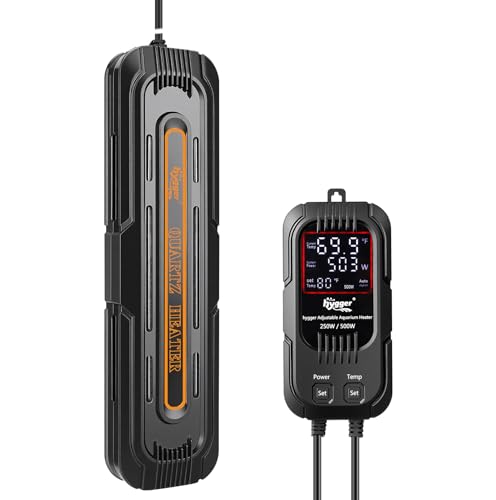
This model offers adjustable power between 400W and 800W, making it flexible for tanks in the 80–132 gallon range. Key advantages include dual power settings to adapt to seasonal or tank changes and strong safety protections, including out-of-water and overheat warnings. Best for hobbyists who want an economical way to manage temperature with a single heater across variable tank sizes. A limitation is that it may require closer monitoring during temperature swings to avoid overshoot when set to 800W in larger tanks.
SEAOURA 800W Heater — External Controller

SEAOURA’s 800W model targets tanks in the 100–180 gallon range, featuring an external controller and temperature probe for flexible placement. It’s designed to respond to tank temperature with more nuanced control and includes over-temp protection and an audible alert. Best for aquarists who want precise remote temperature management, especially in larger or hard-to-reach tanks. A potential caution is the longer setup since the controller and probe placement require planning for optimal measurement accuracy.
MantaMaze 800W Heater — Large Tank Ready

This model supports tanks up to 300 gallons, with two durable quartz glass heating tubes and a flame-retardant outer shell. The external digital controller displays current temperature and setpoint and includes warning indicators for high temperature and out-of-water conditions. Best for aquarists who need fast, even heating with a safety-first design in large or high-traffic tanks. A limitation is that placement of the heater and controller should be considered to prevent accidental contact with tank occupants.
Fishkeeper 800W Adjustable Submersible Heater

Fishkeeper’s heater uses an electronic PID-like control with ultra-safe protections, including run-dry, overheat, and low-temperature protections. The device claims rapid and efficient heating with intelligent power adjustment to reach target temperature quickly and maintain stability. Best for aquariums requiring precise temperature control with strong safety guards. A caution: ensure compatibility with your tank’s dimensions and confirm the external controller positioning to maximize ease of use.
AQQA 800W Large Tank Heater

AQQA’s 800W heater is designed for 80–230 gallon tanks, featuring explosion-proof quartz glass and a high-temperature-resistant shell. It includes an intelligent memory function to retain temperature settings after power loss and has a broad 59–93℉ temperature range. Best for aquarists who want resilience against outages and flexible installation in large tanks. A potential limitation is the need for careful setup to ensure full immersion and consistent heat distribution across larger volumes.
Buying Guide: Key Factors For 800W Heaters
What tank size is appropriate for an 800W heater?
- For most community and reef setups, 80–180 gallons is a common range where 800W is ideal for consistent heating in varying room temperatures.
- For larger or heavily shaded rooms, verify tank dimensions and consult the manufacturer’s wattage chart to avoid overheating or uneven heating.
What features should you prioritize?
- Digital temperature control and sleep-friendly displays help maintain precise temps with minimal drift.
- Overheat and out-of-water protections are crucial in preventing harm to aquatic life.
- External controllers and probes offer flexible placement and easier monitoring without reaching into the tank.
How important is placement and immersion?
- Follow the manufacturer’s immersion depth guidelines to ensure even heat distribution and prevent dry-running.
- External controllers should be positioned to minimize accidental contact with water or tank inhabitants.
What about maintenance and safety?
- Regularly inspect cords and seals for wear. Replace if the glass tube shows cracks or if the protective housing is damaged.
- Keep the heater clean and free of algae buildup to avoid misreadings on temperature controls.
Frequently Asked Questions
- What size tank can an 800W heater handle? – Typically suitable for 80–220 gallons depending on the model and room temperature; always check the manufacturer’s size chart.
- Do external controllers improve accuracy? – Yes, external controllers can provide more consistent readings and safer placement, especially in larger tanks.
- Is dual heating (two heaters) better for large setups? – In some cases, yes, it can distribute heat more evenly; ensure proper synchronization and safety protections.
- What happens if the heater runs dry? – Most models include an out-of-water protection that cuts power to prevent damage or safety hazards.
- Can I use a single 800W heater for a reef tank? – It depends on the total water volume and heat loss; reef tanks may require precise temperature control and stable lighting conditions, so verify compatibility with corals and invertebrates.
- Do 800W heaters consume a lot of power? – They draw significant current, so consider your aquarium setup, room climate, and energy costs when planning heating strategies.