If you maintain a 55 gallon aquarium, you need a heater that provides reliable, precise warmth for both freshwater and saltwater setups. The right heater avoids sudden temperature swings that stress fish and plants. This guide highlights five strong options, explains who each is best for, and notes any limitations. Whether you keep cichlids, tropical community fish, or reef-influenced displays, these heaters aim to deliver steady performance with clear protections and easy operation.
Product Comparison At A Glance
| Product | Best For | Key Benefit | Note |
|---|---|---|---|
| Orlushy Submersible Aquarium Heater, 500W | Large 55 gal tanks, steady heat | High wattage for quick, stable warming | Explosion-proof quartz glass, adjustable thermostat |
| Fluval M 200-Watt Submersible Heater | Mid-sized 55 gal setups | Mirror technology for discreet appearance | Suitable for up to 65 gallons |
| Fluval E 300 Watt Electronic Heater | Precision control fans and monitoring | Real-time digital temperature monitoring | Electronic controls, dual sensors |
| HiTauing 300W/500W Submersible Heater | Flexible wattage needs | Intelligent temp control and water-detection | Over-temperature and dry-run protection |
| AHJ Aquarium Heater, 300W | Safety-first installations | Accurate control with extensive safety protections | PID-enabled, quick heat, anti-dry features |
Orlushy Submersible Aquarium Heater, 500W
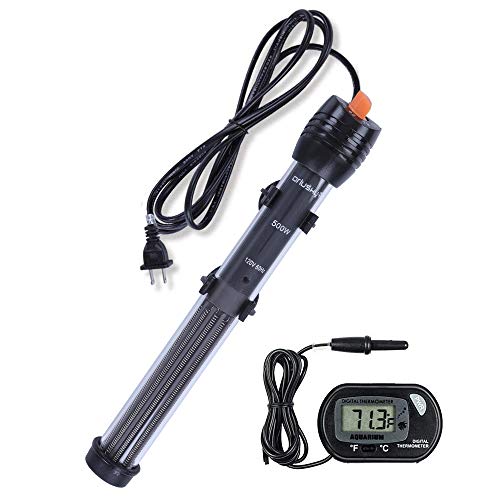
Best for larger 40–75 gallon tanks that need fast and dependable heating. This 500W Orlushy model supports quick warming and stable maintenance with a knob-style thermostat and automatic shutoff at the set temperature. The heater uses a nickel-chromium heating wire and a quartz glass tube for durability in both freshwater and saltwater. It includes two suction cups and a thermometer for real-time temperature monitoring.
Who it’s best for: hobbyists who want a robust, easy-to-read unit with reliable on/off cycling and a built-in thermometer. Why selected: strong wattage aligns with the size of a 55 gallon tank, and the protection features help prevent overheating. Caution: ensure the thermostat is set within a safe range to avoid unnecessary coral or fish stress in sensitive setups.
Fluval M 200-Watt Submersible Heater

Best for tanks near the upper limit of 65 gallons and those prioritizing discreet aesthetics. The Fluval M uses a mirror-like housing to blend with the tank while providing precise heating. It is designed for tanks up to about 65 gallons and includes a robust thermal mechanism with consistent heat output. The compact form makes placement flexible in a 55 gallon setup.
Who it’s best for: aquarists who want an unobtrusive heater with dependable performance. Why selected: the mirror technology makes it easy to hide, preserving the viewing experience. Caution: screen visibility and readouts are crucial—verify you can clearly monitor temperature on the display in your tank setup.
Fluval E 300 Watt Electronic Heater

Best for aquarists who want advanced temperature control with real-time monitoring. The Fluval E 300W features electronic microprocessor-based control with dual temperature sensors to continuously track water temperature. It’s designed for reliability in freshwater or saltwater tanks up to around 75 gallons with a compact footprint that minimizes intrusiveness.
Who it’s best for: keepers who value precise digital readouts and safety features. Why selected: dual sensors and ongoing monitoring support stable temperatures. Caution: repair or replacement may require compatible Fluval components and careful calibration in high-traffic displays.
AHJ Aquarium Heater, 300W

Best for safety-focused aquarists who manage 40–70 gallon tanks. The AHJ heater emphasizes accurate control within plus or minus 1 degree Fahrenheit, using a PID-style control and an integrated safety suite. It includes anti-dry burning and over-temperature protections, plus an automatic shut-off if water is low or temperatures rise beyond the set point.
Who it’s best for: owners seeking precise, stable warmth with enhanced safety protections. Why selected: its comprehensive safety features help reduce risk in busy or novice setups. Caution: the control interface may require a brief learning curve to maximize accuracy in daily use.
HiTauing 300W/500W Submersible Heater

Best for flexible wattage needs in a 55 gallon tank, especially when you’re unsure of precise heating requirements. This HiTauing model offers a 300W or 500W option with intelligent temperature and water sensors. It automatically stops heating if the head is out of water or if the set temperature is exceeded, providing robust protection in both freshwater and saltwater setups.
Who it’s best for: aquarists needing adaptable power to match seasonal heating demands. Why selected: strong safety features and simple on/off logic help prevent overheating. Caution: ensure you select the correct wattage for your tank size to avoid undershooting heat in cooler months.
Fluids and Temperature: Buying Guide For 55 Gallon Heaters
- Tank size and bioload: For a 55 gallon tank, consider heaters in the 200W–500W range depending on whether you run saltwater, freshwater, or a heavily populated display.
- Temperature stability features: Look for precise thermostats, digital displays, or PID-type controls to minimize fluctuations.
- Safety protections: Anti-dry burn, over-temperature shutoff, and automatic power-off when water is low are important for long-term reliability.
- Durability and materials: Quartz glass, nickel-chromium heating elements, and heat-resistant housings extend life in humid, high-temperature environments.
- Placement and visibility: Submersible heaters usually require vertical or horizontal placement; consider models with discreet housings or mirror finishes to preserve tank aesthetics.
- Monitoring: Some units include built-in thermometers or digital displays; others pair with external thermometers for verification.
- Maintenance: Choose heaters with accessible components and clear replacement parts if needed.
Buying Considerations By Scenario
- New hobbyist setting up a 55 gallon tank for tropical fish: start with a 300W heater for a faster warm-up and reliable maintenance, and prefer models with clear safety protections and simple controls.
- Saltwater or reef-friendly displays: prioritize models with explosion-proof glass and corrosion-resistant housings; consider dual-sensor monitoring for precise control.
- Space-conscious layouts: pick compact, discreet units or those with mirror housing to minimize visual impact while maintaining performance.
- Energy efficiency focus: choose heaters with smart or economical heating cycles to reduce electricity usage during cooler nights or seasonal changes.
Frequently Asked Questions
- What wattage should I use for a 55 gallon tank? – Most setups benefit from 300W to 500W, depending on ambient room temperature, fish load, and whether you’re keeping freshwater or saltwater.
- How do I know if the heater is working correctly? – Look for a stable display at the set temperature, a steady heating cycle, and the presence of an indicator light or digital readout showing the current water temp.
- Is a dual-sensor system better? – Yes, dual sensors help ensure the displayed temperature matches actual tank conditions, reducing the risk of overheating or under-heating.
- Can I use more than one heater in a 55 gallon tank? – In some setups, multiple smaller heaters can provide even heat distribution, but ensure you don’t create conflicting safety circuits or hot spots.
- What maintenance is required for submersible heaters? – Regularly inspect for cracks, ensure seals remain intact, and verify temperature readings with an external thermometer to confirm accuracy.
- Are there risks with leaving a heater on all the time? – Modern heaters include automatic shut-off when the target temperature or water level is not maintained; nevertheless, monitor for any failure signs and test weekly.