If you’re shopping for a 500 GPH aquarium pump, you want models that combine dependable flow with quiet operation and easy maintenance. This guide highlights five suitable options, explaining who each is best for, and why they stand out. Whether you’re stocking a small fish tank, a decorative fountain, or a hydroponic setup, these pumps balance performance and practicality for everyday use.
Summary table of selected products
- VIVOSUN 800GPH Submersible Pump — Best for medium tanks needing strong lift and quiet operation
- GROWNEER 550GPH Submersible Pump — Best for versatile setups with multiple nozzle options
- JEREPET 800GPH 30W DC Pump — Best for DC control and adjustable flow
- JEREPOND 660GPH DC Pump — Best for quiet, LCD-controlled flow in larger small tanks
- TONGCHANT 480 GPH Submersible Pump — Best value with three nozzles and ETL protection
VIVOSUN 800GPH Submersible Pump

Best for mid-sized aquariums or ponds that require reliable lift up to ten feet and strong flow. This pump offers a max flow of 800 GPH (3000 L/H) and 24W power, with a 10 ft lift and a choice of nozzles for different water pressures. The flow is adjustable via a control knob, and it’s easy to disassemble for cleaning without tools. Choose this if you need a compact, versatile pump for fountains, hydroponics, or decorative water features in spaces where quiet performance matters.
Best for: hobbyists who value a solid, compact pump with straightforward flow adjustment and multiple nozzle options. Not ideal if you require continuous ultra-low noise at extremely high lift for very large setups.
Caution: Flow rate decreases with higher lift height, so you may see reduced output when the vertical distance is large.
GROWNEER 550GPH Submersible Pump

Best for flexible setups that benefit from three nozzle options and a strong lift up to 7.2 ft. It features a control knob to fine-tune flow and a 30W motor, with a maximum of 550 GPH (2000 L/H). The device is designed for easy cleaning and maintenance, and threaded fittings add stability. This pump is a solid pick for medium tanks, ponds, or hydroponic systems where lift and variable flow are important.
Best for: users who want adjustable pressure and multiple nozzle choices to tailor the water effect. Not ideal if you require a longer outdoor-duty rating or extensive external filtration integration.
Limitation: Outdoor use is possible but consider a residual current protection socket or circuit breaker for weather exposure.
JEREPET 800GPH 30W 16FT Aquarium Pump

Best for systems needing precise DC control with a high lift and a built-in controller. It delivers up to 800 GPH (30W, 24V DC) with a lift of up to 12.5 feet and offers six speed settings, a feeding mode, and a wave maker function. The unit is designed for quiet operation with a ceramic shaft. Choose this if you require adjustable flow with programmable modes for fish tanks, fountains, or hydroponics.
Best for: aquarists needing a controllable, quiet DC pump with programmable modes. Not ideal if you prefer AC-powered pumps or simpler, non-digital controls.
Limitation: The max flow is provided at the largest nozzle with zero lift; flow reduces as lift increases.
TONGCHANT 480 GPH Submersible Pump
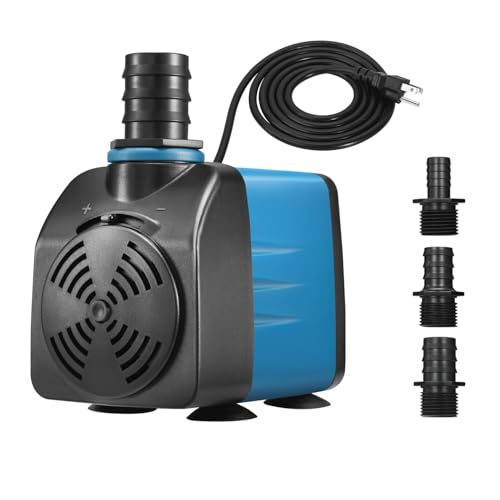
Best for compact, space-conscious setups that still need dependable flow. This 35W pump provides 480 GPH with a maximum lift of 8.2 ft and includes three nozzle options. It’s ETL listed with IPX8-sealed protection and a thermal cut-off for overheating. The design emphasizes quiet operation and durability, making it a reliable choice for indoor aquariums, ponds, or decorative water features.
Best for: small to medium tanks where you want reliable performance with multiple nozzle configurations. Not ideal if you need a higher flow rate than 500 GPH or very long lift.
Limitation: It includes protective features, but high ambient temperatures can still affect performance in outdoor settings.
JEREPOND 660GPH DC Return Pump

Best for quiet, LCD-controlled flow in smaller freshwater or saltwater setups. The JEREPOND Nano 660GPH pump offers a max lift of 10 feet and 20 speeds with a 25W DC motor. The LCD display shows speed and status, and the pump includes a 10-minute feeding mode. It’s a good choice when precise, programmable flow is important for tank stability and aesthetic water movement.
Best for: hobbyists who want granular control and monitoring of flow rates. Not ideal if you prefer a simpler, non-digital mechanism or require exterior mounting rather than submersible use.
Limitation: Some users may need to adjust settings to avoid over-pressurizing small tubing.
Buying Guide
- Flow rate and lift: Aim for a pump that matches your tank size and the height the water must reach. Higher lift reduces flow; plan for a balance between GPH and lift height.
- Power type: AC pumps are common and simple, while DC pumps offer precise speed control. Consider how you’ll wire and control the device in your setup.
- Noise and vibration: Look for pumps marketed as ultra-quiet or with rubber feet and durable impellers to minimize sound and vibration in living spaces.
- Maintenance: Detachability and easy cleaning reduce long-term upkeep. Pumps with fewer screws or tool-free disassembly are convenient.
- Durability and protection: Thermal protection, IP ratings, and ETL listings indicate safer operation in various environments, including outdoors.
- Outlets and fittings: Check nozzle options and compatible hose sizes. Multiple outlets offer flexibility for spray patterns and water features.
- Application fit: Consider whether you need a submersible or inline pump based on your aquarium, fountain, pond, or hydroponic design.
Frequently Asked Questions
- What is a practical lift height for a 20-30 gallon aquarium?
Typically, a lift of 6-7 feet is sufficient for most small to medium tanks; ensure the pump’s flow remains adequate at your chosen height.
- Is a DC pump better than an AC pump for aquariums?
DC pumps offer adjustable speed and programmability, which can be beneficial for fine-tuning flows; AC pumps are typically simpler and reliable.
- Do I need a special outlet for outdoor use?
Yes. When using outdoors, use a residual current device (RCD) or a weather-protected circuit to minimize risk.
- How often should I clean my pump?
Regular cleaning every few months is common, especially in systems with mineral buildup or algae growth.
- What nozzle configuration should I choose?
Start with the standard nozzle and adjust to achieve the desired flow pattern; three-nozzle options give flexibility for different water effects.