When you search for a 400 watt aquarium heater, you want reliability, safety, and precise temperature control for your aquatic pets. This guide highlights five strong options that balance performance and value for different tank sizes and setups. The best choice depends on tank volume, whether you prefer external controllers, and how important features like auto shut-off or fail-safe heating are for you. Suitable buyers include hobbyists with mid-to-large freshwater or saltwater tanks, reef keepers needing stable temps, and those who want easy external controls for monitoring.
Summary table of selected products.
| Product | Wattage Options | Best For | Notes |
|---|---|---|---|
| Hygger Aquarium Heater (400W/800W) | 400W / 800W | Medium-to-large tanks (80–132 gallons) | External controller, multiple safety protections |
| Hydor Theo Shatterproof 400W | 400W | Large 80–105 gallon tanks | Shatterproof, fully submersible, flexible placement |
| HiTauing 500W Submersible Heater | 500W | 75–120 gallon tanks | Intelligent sensor, digital control, safety protections |
| HITOP 400W PTC Heater | 400W | 55–100 gallon tanks | PTC material, external digital controller |
| Hygger Tri-Power 400W-800W-1200W | 400W / 800W / 1200W | All-season versatility for variable climates | Triple-channel control, external display |
Hygger 400W/800W Adjustable Power Heater
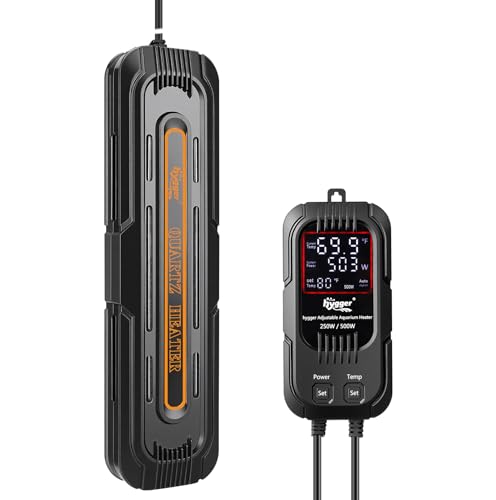
Best for mid-to-large tanks that need flexible power, this hygger heater supports 400W or 800W operation. The external controller displays current water temperature, set temperature, current power, and error codes in real time. It includes multiple safety protections: off-water cutoff to prevent dry heating, over-temperature warnings, and low-temperature alarms. The temperature range is 59℉ to 93℉, suitable for freshwater and saltwater setups up to 132 gallons. The dual-power design makes it adaptable to seasonal heating needs, without buying separate units.
Who it’s best for: aquarists with 80–132 gallon tanks seeking a single heater that can adapt to seasonal changes and different stocking levels. Why selected: flexible wattage minimizes extra equipment while external controls support precise temp management. Limitation: ensure proper water coverage and immersion to avoid false readings on the digital display.
Key features in brief:
– Adjustable power: 400W or 800W
– External controller with LED display
– Temperature range 59℉–93℉
– Safety: out-of-water cutoff, high/low temp alarms
Orlushy Submersible Heater 500W
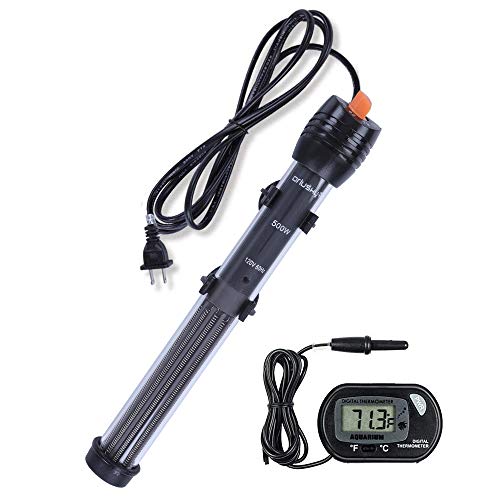
This 500W model is designed for 40–75 gallon tanks and uses a reliable thermostat to maintain uniform temperature. It is built with 2mm thick quartz glass and a corrosion-resistant exterior suitable for both freshwater and saltwater. The 6-foot power cord provides flexible placement inside the aquarium. This solution is best for mid-sized tanks that require a dedicated heater with straightforward control. Caution: ensure wattage aligns with your tank size to avoid under-heating in larger setups.
Who it’s for: aquarists with 40–75 gallon tanks who want dependable performance and robust glass protection. Why selected: strong construction with explosion-proof glass helps prevent breakage. Limitation: not the best option for very large or heavily populated tanks where higher wattage may be needed.
HiTauing 500W Submersible Heater
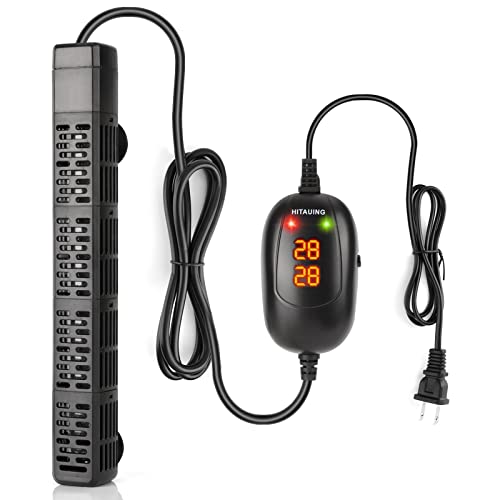
Designed for 75–120 gallon tanks, this 500W heater uses a stable nickel-chromium heating element for rapid, uniform heating. It features a built-in temperature controller with Fahrenheit and Celsius settings and a wide range of 63-94℉ (17-34℃). A key safety system includes an intelligent water sensor: heating stops if the heater is out of water or if the temperature exceeds the set point. The exterior is an explosion-proof quartz tube with a robust ABS housing. Best for: larger tanks needing accurate control and enhanced safety against dry-run risks. Caution: ensure correct orientation and full submersion for accurate readings.
HiTauing 300W/500W Upgraded Heater

This upgraded model provides 300W or 500W options, ideal for 40–75 gallon tanks. It uses quartz glass for durability and includes intelligent temperature control with a 63-94℉ range. The external controller displays both current and target temperatures, and the heater head is equipped with safety features to stop heating if the water level drops. Best for modest-sized aquariums requiring reliable, compact heating solution. Limitation: not the best fit for very large aquariums or very high-temperature requirements.
HITOP 400W PTC Heater With Controller

This 400W option targets tanks in the 55–100 gallon range with a digital external controller. It uses PTC (positive temperature coefficient) heating material for safe, efficient operation and features a temperature range of 68–93 ℉. The combination of a compact design and an external display helps keep your setup tidy while giving you precise control. Choose this if you want a sturdy, simple external controller and a compact heater. Caution: confirm compatibility with your tank mix and aquarium inhabitants, as smaller tanks sometimes require careful temperature management to avoid overheating.
Hygger Tri-Power 400W-800W-1200W Heater

Designed for year-round versatility, this hygger heater offers three wattage settings (400W, 800W, 1200W) via an external controller with power display. It allows current and set temperatures to be watched side-by-side, making it easier to compare and adjust. The three-tube independent design ensures operation even if one tube fails, which is a practical safety feature for larger or heavily stocked tanks. Best for: homes with variable climates or users who want a single unit that scales to different tank volumes. Limitation: the triple-tube design may require more space and thoughtful placement to avoid obstruction of tank aesthetics.
Buying Guide: Key Factors To Consider
- Tank size compatibility: Match wattage to gallon capacity. Larger tanks generally require higher wattage or multiple tubes for even heating.
- External vs. internal control: External controllers simplify monitoring and reduce tank clutter but require proper installation and cable management.
- Safety features: Auto shut-off on low water, over-temperature protection, and dry-run warnings are essential for safeguarding fish and invertebrates.
- Temperature range and precision: Ensure the heater supports your target range with fine adjustment capability. Fahrenheit-to-Celsius switching is helpful for global users.
- Durability and materials: Quartz glass and corrosion-resistant housings improve longevity in both freshwater and saltwater setups.
- Redundancy considerations: In very critical systems, consider a second heater or a dual-stage setup to prevent temperature swings.
What to Ask Before Buying
- What is the tank’s gallon capacity and typical ambient temperature?
- Is an external controller preferable for monitoring and adjustments?
- What safety features are non-negotiable for your ecosystem?
Installation And Maintenance Tips
- Place the heater where water flow is active to avoid hotspots, and ensure it remains fully submerged per manufacturer guidance.
- Calibrate a reliable thermometer to regularly verify temperature accuracy.
- Inspect seals and power cords for wear, and replace any damaged components promptly.
FAQ
- Q: Can I use a 400W heater in a 120-gallon tank? A: It may be inadequate; consider a higher wattage or supplementary heating to maintain stable temperatures.
- Q: Are external controllers necessary? A: They help with precise control and monitoring, especially in larger or sensitive setups.
- Q: What happens if the heater runs dry? A: Many models feature an off-water protection to stop heating automatically.
- Q: Is 93°F too high for tropical freshwater fish? A: It depends on species; most tropical species prefer 76–82°F, so adjust within species-specific ranges.
- Q: Do all heaters work with saltwater? A: Most do, but confirm corrosion resistance and suitable wattage for salted environments.