Answering the needs of large aquariums, these heaters are designed to reliably regulate water temperature in 125-gallon tanks. The best options balance safety, accuracy, and ease of use for both freshwater and saltwater setups. This guide highlights five strong choices and who they’re best for, plus a buying guide to help you pick the right wattage and protection features for your tank.
| Product | Best For | Wattage Range | Key Protection |
|---|---|---|---|
| Hygger 800W Submersible Heater | Large freshwater or saltwater tanks up to 220 gal | 800W | Overheating and out-of-water protection; digital LED controller |
| Hygger 500W Submersible Heater | Tanks around 66–135 gal; versatile for large setups | 500W | Overheat & water-out protection; digital LED controller |
| Hygger 300W Submersible Heater | Medium-large tanks; best for staged setups or multiple heaters | 300W | Overheat and out-of-water protection; digital LED controller |
| HiTauing 500W Submersible Heater | Reliable option for large tanks; robust build | 500W | Intelligent water sensor; over-temperature protection |
| HITOP 600W Submersible Heater | Large seawater or freshwater tanks; external controller | 600W | External controller; memory function; durable housing |
Hygger 800W Submersible Heater — Big Tank Control

The 800W model is designed for tanks from 80 to 220 gallons, making it a strong fit for the 125-gallon range. It features a digital LED controller with a 59℉–93℉ (15℃–34℃) setpoint, and it reports current temperature and service status. The heater includes auto shutoff for high or low temperature and out-of-water conditions. Best for aquarists seeking precise control in large reservoirs. A caution: ensure adequate immersion and follow the size chart to avoid over-sizing the heater for smaller systems.
Best for: large freshwater or saltwater tanks where precise temperature maintenance matters and you want a single, high-capacity unit. Choose this if your setup runs at or near the upper end of the 125-gallon category and you value on-board monitoring.
Hygger 500W Submersible Heater — Balanced Power

The 500W model covers roughly 66–135 gallons, making it a versatile option for larger tanks that don’t require the highest wattage. It includes overheat protection, out-of-water detection, and a digital controller with a similar 59℉–93℉ range. The controller bracket allows temperature adjustments from the tank edge. Best for: setups where energy use matters but you still need robust heating in a single-unit heater. Limitation: performance depends on correct placement and water flow to prevent localized temperature differences.
Best for: mid-to-high demand large tanks where dependable control is needed without going to the maximum wattage.
Hygger 300W Submersible Heater — Compact Yet Capable

The 300W unit works well for multi-setup configurations or as a secondary heater in a 125-gallon system, offering the same digital LED controller and safety protections. Temperature range is 59℉–93℉ with ±1°F accuracy. It provides automatic cutoffs for high temp and out-of-water events. Best for: smaller sections within a large tank or backup heater strategies. Caution: single 300W may be insufficient if ambient conditions are extreme.
Best for: supplementing heating in larger displays or for dual-heater arrangements to balance heat across the tank.
HITOP 600W Submersible Heater — External Controller

The HITOP 600W model is designed for 75–125 gallon tanks and uses an external controller to adjust temperature without direct water contact. It includes a memory function to restore settings after power outages and a durable outer shell with a removable cover for easy cleaning. Best for: users who prefer external control to minimize disturbance inside the tank. Limitation: external controllers may require careful cable management to avoid heat loss or interference.
Best for: aquarists who want hands-off operation with a robust, high-widelity controller in larger tanks.
Orlushy Submersible Heater — Real-time Temperature Monitoring
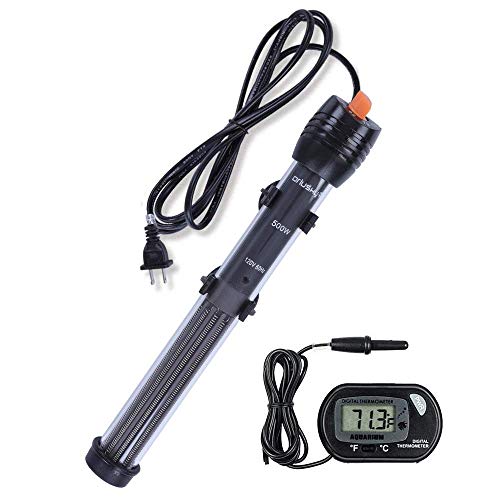
Orlushy offers six sizes, with a stable stair-step heating pattern; red indicates active heating, green indicates steady temperature. It ships with a built-in thermometer for real-time monitoring and uses nickel-chromium wire in a durable quartz glass body. Best for: users who want straightforward temperature tracking in larger tanks and a fall-back option for redundancy. Caution: verify the wattage matches your tank volume for consistent performance.
Best for: dependable basic heating with easy monitoring in sizable displays where extra instrumentation is valued.
Buying Guide: How To Pick The Right 125-Gallon Heater
What wattage should you choose? For a 125-gallon tank, a heater in the 500–800W range is typically appropriate, depending on room temperature, whether the tank is heavily planted, and whether you run multiple heaters for redundancy. Use a slightly lower wattage if your room stays warm or you have strong water movement. Consider dual heaters if you want even heat distribution and a safety margin.
What safety features matter? Look for automatic shutoff on leave-water (out-of-water) and high/low temperature protection to prevent fish stress or death. An e.g., LED temperature display and external controllers can improve accessibility and reduce the need to reach into the tank.
Do you need external vs. internal controllers? External controllers reduce water contact and simplify adjustments. Internal digital controllers are compact and integrate temperature readouts with warnings. Choose based on your preference for accessibility and maintenance routine.
What about durability and materials? Quartz glass tubes and high-grade heating wires (nickel-chromium) offer faster heating and longer life. A durable ABS shell adds resistance to knocks and makes cleaning easier, especially in large tanks.
Placement tips: position heaters where water flows to minimize hot or cold spots. In a tank with strong currents, you may need two units or a larger single unit to maintain uniform temperature.
FAQ
- Can I use a single heater for a 125-gallon tank? Yes, but choose a wattage in the 500–800W range depending on room conditions and tank layout. For extra safety, consider a second heater as a backup.
- Is it safe to run multiple heaters in one tank? Yes, provided they are of appropriate wattage and evenly distributed to prevent temperature differentials.
- What if the heater shows an error or power outage? Many models feature auto shut-off and a low/high temp alert. Some include memory functions to restore settings after outages.
- Do I need an external controller? External controllers reduce water contact and make temperature adjustments easier, though internal controllers are also effective in many setups.
- How do I avoid overheating my tank? Use the built-in protective features and place heaters where water flow is strong. Avoid placing heaters near direct heat sources or under accessories that impede heat distribution.