If you need a reliable heater for a 100-gallon aquarium, this guide highlights the best options designed to maintain stable temperatures for both freshwater and saltwater setups. These picks are best for hobbyists managing large tanks, community tanks, or reef-ready displays. The list emphasizes safety features, automatic shutoff, and precise temperature control to protect fish and aquatic life. Below is a quick summary of five suitable products, followed by detailed sections to help you compare at a glance.
| Product | Best For | Wattage | Notes |
|---|---|---|---|
| SEAOURA Aquarium Heater, 800W | Large tanks, saltwater or freshwater | 800W | Internal temp probe and external controller |
| Hygger Aquarium Heater, 800W | Very large tanks requiring rapid heating | 800W | Over-temp protection and LED indicators |
| AHJ Aquarium Heater, 500W | 75–120 gallon tanks | 500W | Accurate temperature control with safety protections |
| HiTauing Aquarium Heater, 500W | 75–120 gallon setups | 500W | Explosion-proof glass and intelligent control |
| Orlushy Submersible Heater, 500W | 40–75 gallon tanks (as listed) | 500W | Adjustable thermostat and two suction cups |
SEAOURA 800W Aquarium Heater

Features: Temperature probe and intelligent controller provide precise monitoring. External controller allows convenient temp setting. Over-temperature protection with an alarm ensures safety. The unit is designed for tanks from 100 to 180 gallons. Best for: large, mixed-species aquariums where stable heating is critical. Limitation: external controller setup may require extra space and cable management around the tank.
SEAOURA 800W Aquarium Heater — Best For Large Tanks
Best for: those needing robust heating for 100–180 gallon tanks, including saltwater setups with higher thermal demands. Caution: ensure proper submersion and follow installation guidelines to avoid false readings.
HiTauing 300W/500W Submersible Heater

Features: Explosion-proof quartz glass with nickel-chromium heating wire; adjustable range and dual-temperature modes. Best for: mid-to-large tanks where quick heating and safety are priorities. Limitation: 300W version is better suited for up to 75 gallons, while 500W versions cover larger needs but still requires correct sizing for stability.
AHJ 500W Submersible Aquarium Heater

Features: Accurate temperature control with a PID-based sensor, auto shut-off, and safety protections against overheating and dry burning. Best for: 75–120 gallon tanks seeking precise temperature management. Caution: The control logic relies on immersion depth and sensor placement; improper positioning may affect accuracy.
Orlushy 500W Submersible Heater
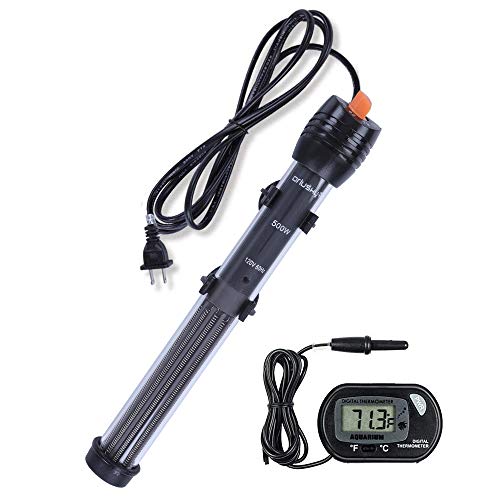
Features: Adjustable thermostat with two suction cups and a free thermometer for real-time monitoring. Best for: mid-sized tanks in 40–75 gallon range needing reliable, simple control. Limitation: Primary suitability is stated for smaller volumes; for a 100-gallon system, pairing with a higher-wattage unit may be advisable.
HiTauing 500W Submersible Heater

Features: Explosion-proof quartz glass, rapid heating, and intelligent water sensor ensures auto-stop if out of water. Best for: 75–120 gallon tanks needing safe, fast and reliable operation. Caution: Always verify compatibility with your tank’s dimensions and substrate depth to ensure full immersion.
Buying Guide: How to Choose a 100 Gallon Tank Heater
What wattage do you need for a 100-gallon tank?
- General rule: for 100 gallons, 4–5 watts per gallon is common in very cold rooms; many hobbyists use 500–800W heaters. In warmer rooms or reef systems, lower wattage may suffice; for cooler rooms, higher wattage helps maintain stable temperatures.
What safety features matter?
- Over-temperature protection and dry-burning protection reduce risk of overheating when water is low or absent.
- Explosion-proof or thick quartz glass provides durability in larger tanks.
- Automatic shut-off when water is out of the tank prevents dry heating.
Should I use one heater or two?
- For a 100-gallon tank, two smaller heaters can provide redundancy and more uniform heat distribution, especially in cold environments or through a large tank footprint. Ensure both are controlled to avoid temperature overshoot.
What about monitoring and control?
- Internal temperature probes, external controllers, and digital displays help maintain precise temps. A separate thermometer is useful for cross-checking readings.
- Look for a heater with a broad temperature range and audible or visible alarms if the setpoint is reached or exceeded.
Placement and installation tips
- Place heaters away from tank corners and obstructions to ensure even heat distribution.
- Follow manufacturer immersion depth and mounting instructions; use suction cups or brackets as provided.
- Regularly inspect for signs of wear, corrosion, or temperature fluctuations.
FAQ
-
Q: Can I run a 100-gallon tank heater in saltwater and freshwater?
A: Yes. Choose a heater described as suitable for both saltwater and freshwater; quartz glass and corrosion-resistant components are beneficial in saltwater environments. -
Q: Do heaters need a separate thermometer?
A: A separate thermometer provides an independent temperature readout and can validate the heater’s controller display. -
Q: Is it better to use one high-wattage heater or two lower-wattage units?
A: Two units provide redundancy and more even heating; a single unit can work if sized correctly for the tank and room temperature. -
Q: What safety features should I prioritize?
A: Look for over-temperature protection, dry-run protection, explosion-proof components, and automatic shut-off when water levels are low. -
Q: How do I know the correct wattage for my tank size?
A: Refer to the tank volume, room temperature, and desired stability. Manufacturers’ wattage charts and third-party guides can help determine appropriate sizing. -
Q: Can I install heaters outside the water?
A: No. Heaters are designed to operate submerged. Outdoor placement can cause failure, leakage, or safety hazards.