For planted freshwater tanks, maintaining stable CO2 levels and precise pH control is essential for healthy plant growth and algae balance. The following picks bring reliable CO2 regulation, monitoring, and automation to American aquarists. Each option below integrates with typical hobby setups, helping you keep consistent CO2 perfomance and water chemistry without constant manual adjustments.
| Product | Brand | Key Strength |
|---|---|---|
| FZONE Aquatic CO2 Glass Drop Checker | FZONE | Simple CO2 readouts via color change |
| FZONE Pro Series CO2 Regulator | FZONE | Dual stage with adjustable output |
| Hygger CO2 Aquarium Regulator | Hygger CO2 | Durable build with precise tuning |
| FZONE Aquatic CO2 Glass Drop Checker PH Monitor | FZONE | Glass drop checker with 4dKH solution |
| Yewhick WiFi pH & Salinity Monitor | Yewhick | Online monitoring with CO2 control compatibility |
FZONE Aquatic CO2 Glass Drop Checker

The FZONE Glass Drop Checker uses a reliable 4dKH solution to display CO2 levels through color, offering quick, at-a-glance readings. Setup is straightforward: fill the checker to half, attach to the tank glass, and recheck after about an hour for an accurate reading. Color indicators simplify monitoring: BLUE indicates more CO2 is needed, GREEN shows sufficient CO2, and YELLOW flags too much CO2. This tool helps keep CO2 steady for plant health without frequent adjustments.
FZONE Pro Series Dual Stage CO2 Regulator

The FZONE Pro Series regulator features dual-stage construction for stable output, reducing risk from end-of-tank dumps. It offers adjustable output from 0 to 65 PSI, with two independent manifold blocks that can operate separately—use one block for a single aquarium or both for two tanks. A built-in safety valve releases pressure above 100 PSI, ensuring safer operation. The precise needle valve allows slow, controlled gas flow as fine as one bubble every three seconds.
Hygger CO2 Aquarium Regulator

Hygger’s regulator combines a robust aluminum body with a dual-dial display for clear readings. It includes a 12V DC solenoid valve for automation and a precise needle valve for tuning. The setup supports CGA320 CO2 tanks and features a thicker acrylic bubble counter with a check valve to prevent water ingress. The design emphasizes safety, reliability, and compatibility with common CO2 diffusers in planted tanks.
FZONE Aquatic CO2 Glass Drop Checker PH Monitor

This FZONE PH monitor entry uses a drop-checker with a highly accurate 4dKH solution, delivering an easy installation that visually reflects CO2 status after about an hour. Like the first drop checker, it uses color codes for quick interpretation: BLUE = needs CO2, GREEN = balanced, YELLOW = too much CO2. It remains a simple, passive method ideal for hobbyists who prefer visual cues alongside their routine maintenance.
Yewhick WiFi pH Monitor and Controller

The Yewhick system provides online monitoring of pH, salinity, and temperature with WiFi access. It can integrate with a CO2 pump to adjust CO2 release automatically based on pH targets, enabling remote control via a Tuya-compatible app. This approach supports continuous pH stabilization and can be valuable for larger or more technologically integrated aquariums where remote oversight improves consistency and plant health.
Hygger CO2 Nano Drop Checker

Hygger’s Nano Drop Checker offers a glass-based CO2 monitoring solution with a simple color readout. Its curved glass design helps with precise placement and readability, and the suction cup mount allows flexible positioning within the tank. This tool complements a larger CO2 system by providing an ongoing, visual CO2 status check for planted aquariums.
Hygger CO2 Regulator with Side-Outlet
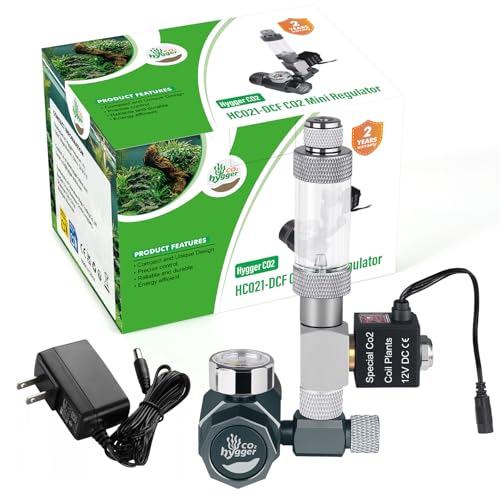
This Hygger model features a detachable design and side-outlet configuration for stable CO2 injection. It comes with a 12V DC solenoid valve for automated control and a high-precision needle valve to tune the output, enabling users to achieve precise dosing. The side-outlet setup minimizes leaks and suits tanks with space constraints near the filter or lighting.
Pawfly Drop Checker Kit

The Pawfly kit provides a complete CO2 monitoring bundle with curved glass tubing, a reagent bottle, and two suction cups. It’s designed for quick setup and simple interpretation: after about two hours, color changes indicate CO2 balance. It’s a practical option for hobbyists who want an all-in-one solution with minimal assembly.
Buying Guide
- CO2 monitoring vs. control: Drop checkers provide visual CO2 readings, while regulators and solenoids actively manage CO2 delivery. A combined approach (monitoring plus automated regulation) offers consistency for planted tanks.
- Regulator stability: Dual-stage regulators minimize pressure fluctuations as gas is consumed, reducing the risk of end-of-tank dumps and unstable CO2 dosing.
- Valves and precision: A high-precision needle valve allows fine adjustments. Look for models with easy-to-read gauges and repeatable control over very small CO2 increments.
- Safety features: Built-in safety valves and check valves protect the system from leaks and excessive pressure, which is especially important with pressurized CO2 in aquariums.
- Materials and compatibility: Aluminum regulators resist corrosion, while compatibility with common CGA320 tanks and diffusers ensures broad applicability across brands.
- Automation options: Online monitoring or app-based controllers enable remote adjustments and alerts, which can be beneficial for busy hobbyists or larger tanks.
- Installation space: Consider the layout of your cabinet or stand. Side-outlet regulators and compact drop-checkers fit better in tight spaces near filters and power strips.
- Maintenance and cost: Some kits include everything you need for a complete setup, while others require separate purchases for solenoids, bubble counters, or check valves. Factor long-term maintenance into the total cost of ownership.
- Tank size and plant load: Larger tanks or densely planted aquariums typically require more robust regulators and controlled CO2 injection schedules. A modular approach lets you scale up gradually.
- Monitoring frequency: Simple color-changing drop checkers work well for daily life, but automated sensors with drills down into pH, temperature, and salinity provide deeper insights for advanced aquascapes.
When selecting a CO2 and pH solution for an aquarium, balance simplicity with control. For beginners, a drop checker paired with a reliable regulator offers a solid start. For more advanced setups, consider adding a WiFi-enabled monitor or automatic control so you can maintain stable conditions with minimal manual intervention.