Looking for an air pump to keep your fish tank well-oxygenated and visually calm? This guide highlights five reliable options suited for a range of tanks, from small to large, fresh or saltwater. Each pick prioritizes quiet operation, steady airflow, and dependable dual-outlet designs when useful. The top buyers are hobbyists setting up fry tanks, hobbyists upgrading aeration for larger tanks, and those seeking low-energy options for quiet homes or apartments.
Summary table of selected products
| Product | Best For | Key Benefit |
|---|---|---|
| Uniclife 64 GPH Aquarium Air Pump | Mid-sized tanks (10-100 gallons) | Dual outlets with adjustable flow |
| Pawfly Aquarium Air Pump 50 GPH | Up to 60 gallons; budget-friendly | Low power, quiet operation |
| AQQA Aquarium Air Pump 3W | Medium to large tanks; larger setups | Stainless steel dual outlets; low noise |
| HITOP Dual Outlet Aquarium Pump | 10-100 gallon setups needing reliability | Whisper-quiet with adjustable flow |
| AQUANEAT 300GPH Aquarium Air Pump | Large tanks up to 200 gallons | High airflow, multiple outlets |
Uniclife 64 GPH Aquarium Air Pump
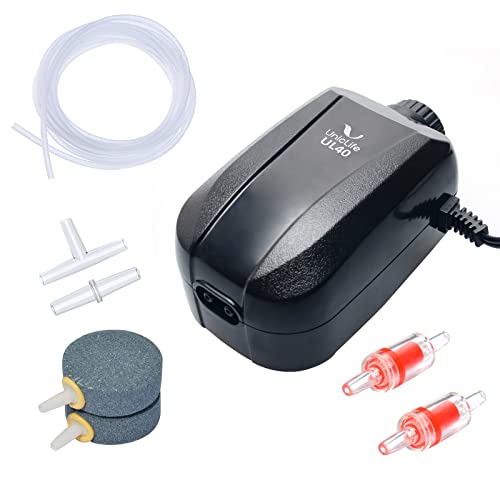
Best for mid-sized tanks from 10 to 100 gallons, this pump delivers a steady 64 GPH airflow with dual outlets for multi-point aeration. It includes an adjustable rotary knob to tailor air flow for your tank’s needs, helping spread oxygen effectively across deeper substrates. It operates quietly, emitting about 25 dB on the low setting and up to 45 dB at high output, making it a practical choice for bedrooms or offices. A potential caveat is that air volume can drop if intake cotton becomes blocked; regular maintenance is advised.
Best for: hobbyists who want adjustable, dual-outlet aeration without adding excessive noise. Choose this if you need reliable performance across a broad range of tank sizes and want a straightforward setup.
Pawfly Aquarium Air Pump 50 GPH

Best for small to medium tanks up to 60 gallons, the Pawfly 50 GPH unit emphasizes low energy use with a simple rotary air-flow control. Four shockproof feet help minimize vibration, and the noise level is described as less than 30 dB, making it a strong choice for quiet environments. A limitation is that very large aquariums may require higher-capacity units for even aeration performance.
Best for: budget-conscious keepers who want quiet operation and dependable airflow in compact setups. Opt for this if you prioritize energy efficiency and a compact footprint.
AQQA Aquarium Air Pump (3W)

Best for larger setups needing higher air volume with quiet operation, this 3W pump has dual stainless steel outlets and a claimed airflow up to 100 GPH with a max pressure around 18 KPa. The heavy-duty housing and four rubber pads dampen vibration, helping keep noise down to about 35 dB. For very small tanks or saltwater systems that require ultra-light, tiny pumps, this may be overkill.
Best for: aquarists seeking robust aeration for bigger tanks or multi-tank installations. Choose this if you want a durable dual-outlet pump with relatively low noise for its power class.
HITOP Dual Outlet Aquarium Pump

Best for mid-to-large tanks needing adjustable airflow, this 3W unit emphasizes ultra-quiet operation and a practical dual-outlet design. ABS engineering plastics help minimize sound, and motor performance is described as stable with a lower failure rate due to the straightforward manual adjustment. A limitation is that the exact airflow can vary with tank depth and tubing layout; users should verify fit for their specific setup.
Best for: aquarists who want a quiet, dependable pump with easy flow control. Pick this if you value a simple, robust design and don’t need stealth-level ultra-quiet performance in ultra-large tanks.
AQUANEAT Aquarium Air Pump 300GPH

Best for large tanks up to 200 gallons, this AQUANEAT model delivers high airflow with a 300 GPH rating and four outlets, suitable for running multiple airstones, sponge filters, or decorative bubblers. It includes a flow-control knob to adjust delivery and four rubber feet to reduce vibration. The trade-off is that higher output pumps tend to produce more noise than smaller units, so placement and tubing routing matter for a quiet setup.
Best for: owners who need substantial aeration across a large aquarium or a multi-tank system. Choose this if you require strong airflow and the ability to run several devices from one pump.
Buying Guide: Key Considerations For Choosing An Aquarium Air Pump
- Tank size and aeration needs: Larger tanks generally require higher GPH and multiple outlets. For up to 100 gallons, mid-range models are often sufficient; for 200+ gallons, look for 300 GPH or higher with multiple outlets.
- Noise and vibration: Look for pumps with rubber feet, solid housings, and minimal exposed motor vibration. If you have a bedroom or office, prioritize models marketed as whisper-quiet.
- Airflow control: Rotary knobs or adjustable outlets let you tailor aeration to plant or fish needs and biofilter performance. Dual outlets can oxygenate different tank zones simultaneously.
- Maintenance needs: Consider pumps that are easy to disassemble for cleaning. Regular cleaning of intake components helps maintain airflow and prevents drop in performance.
- Power efficiency: Pumps with low wattage achieve similar aeration at lower energy costs, making them suitable for long-term use in homes with electricity considerations.
- Durability and materials: Stainless steel outlets and sturdy housings withstand longer service life, especially in saltwater systems where corrosion can be a concern.
- Compatibility: Ensure tubing size matches your existing airline tubing and that the pump supports the desired number of outlets and stones or sponges.
Frequently Asked Questions
- What size air pump do I need for my tank?
Estimate based on tank volume: roughly 1–2 GPH per gallon for basic aeration; for tightly planted or heavily filtered tanks, consider higher outflow and multiple outlets.
- Are dual-outlet pumps worth it?
Yes, if you want even oxygen distribution or plan to run multiple accessories like sponge filters or air stones in different tank zones.
- How loud are these pumps typically?
Many models advertise 25–45 dB at normal operating settings; placement on a sturdy surface away from living areas can further reduce perceived noise.
- How often should I clean an air pump?
Regularly inspect intake cotton or filters and tubing for buildup. Clean or replace blocked components to restore airflow.
- Can I use an aquarium air pump in saltwater tanks?
Most are suitable for both freshwater and saltwater, but check the model’s materials for corrosion resistance and ensure proper compatibility with saltwater settings.
- Is higher wattage always better?
Not necessarily. Higher wattage can provide more air but also more noise and heat. Choose based on required airflow and tank size rather than wattage alone.