Answering the core question for buyers: the best submersible aquarium heaters deliver reliable, stable heating while staying safe in both freshwater and saltwater habitats. This guide highlights five practical options and explains who each is best for, based on tank size, temperature control, and safety features. Ideal buyers include beginners setting up small nano tanks, hobbyists maintaining mid-sized community tanks, and owners seeking precise digital controls for stable temps. Below is a quick comparison table of the five selected products to help you decide at a glance.
| Product | Best For | Tank Size Range | Key Benefit |
|---|---|---|---|
| Orlushy 500W Submersible Heater | Medium to large tanks | 40–75 gallons | Strong, adjustable thermostat |
| HiTauing 300W Heater | 40–75 gallon setups | 40–75 gallons | Intelligent protections, safe design |
| hygger Small 10W Heater | Small tanks | 1–5 gallons | Compact, quartz glass |
| AQUANEAT 50W Heater | Medium nano to small community tanks | 5–15 gallons | Easy adjustment, steady temp |
| Fluval P25 Submersible Heater | Nano tanks | Up to 6 gallons | Preset temp, shatterproof |
Orlushy 500W Submersible Heater
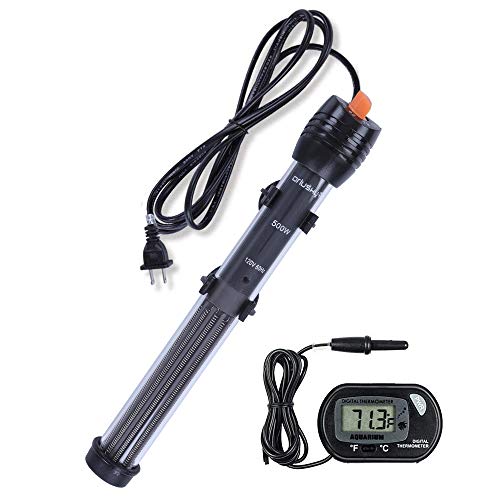
The Orlushy 500W model provides robust heating for larger community tanks and dedicated marine setups. Its thermostat maintains a uniform temperature and shuts off when the target is reached, helping conserve energy. The outer shell uses heat-resistant ABS, and the heating element uses nickel-chromium wire with a quartz glass core for durability. This unit is best for aquariums that require steady warmth in the 40–75 gallon range. A separate thermometer is included for real-time monitoring. Limitations include the need for proper mounting space and ensuring the tank volume matches the wattage recommendation.
Who it’s best for
Best for hobbyists with mid-to-large tanks needing a dependable heater with straightforward control and a thermometer for quick checks.
Why chosen
Selected for its combination of durable construction, stable heating, and included thermometer, which helps monitor temperature without guessing.
Limitations to note
Higher wattage requires adequate space and power safety planning; ensure compatibility with your tank dimensions and setup.
HiTauing 300W Heater
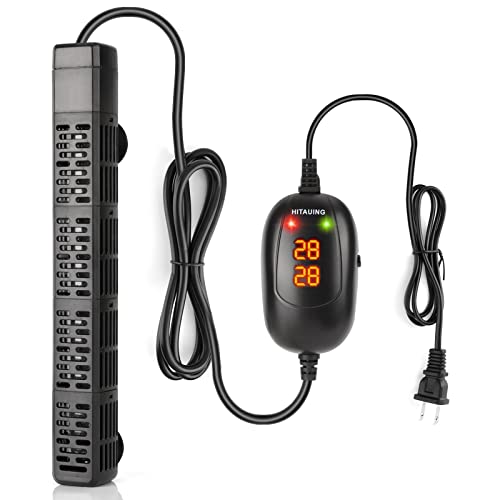
The HiTauing 300W heater is designed for 40–75 gallon tanks and offers rapid, stable heating with a built-in temperature control system. It features Fahrenheit and Celsius readings and a range of 63–94°F (17–34°C). The unit uses explosion-proof quartz glass and a high-temperature ABS shell. Its intelligent water sensor automatically stops heating if the heater is out of water or if the temperature exceeds the set point. This makes it a safe choice for both saltwater and freshwater aquariums. A potential caveat is the need to ensure correct mounting and power access in taller tanks.
Who it’s best for
Choose this if you want a high level of safety features and clear temperature readouts for mid-to-large tanks.
Why chosen
Selected for strong safety protections, quick heat-up, and robust materials that withstand regular submersion in diverse water types.
Limitations to note
Set-up requires accurate tank sizing to match the 300W rating; incorrect wattage can lead to over- or under-heating in smaller setups.
hygger Small 10W Heater

The hygger 10W heater is tailored for tiny tanks (up to 5 gallons) and is suitable for both freshwater and marine environments. It uses a 2mm thick quartz glass element for improved resistance to breakage and corrosion. The heater includes dry-run and overheating protection, displaying error codes (HH for high temp, E1 for out of water) to guide quick troubleshooting. It’s best for nano tanks where precise temperature control is less intense but reliability is essential. A limitation is its small wattage, which may not maintain stable temps in lightly loaded systems with high heat loss.
Who it’s best for
Ideal for nano tanks or betta bowls needing a compact heater with basic safety protections.
Why chosen
Selected for small size, solid quartz construction, and straightforward protections that help prevent accidental overheating.
Limitations to note
Not suitable for larger or heavily loaded tanks where heat loss is greater than what a 10W unit can counteract.
AQUANEAT 50W Heater

The AQUANEAT 50W heater is designed for 5–15 gallon tanks. It features an adjustable top dial for temperature control (65–89°F) and a red indicator light that signals when the target temperature is reached and stabilized. Made for both marine and freshwater setups, this model emphasizes ease of use and steady operation. A notable consideration is that larger tanks outside the specified range may require a higher wattage to achieve and maintain the desired temperature consistently.
Who it’s best for
Best for small-to-mid tanks where simple, reliable temperature control is sufficient and precision controls are not a priority.
Why chosen
Selected for approachable adjustability and a straightforward, visible indicator that helps beginner aquarists monitor heating status at a glance.
Limitations to note
Limited to 5–15 gallon tanks; for larger aquariums, a higher-wattage heater is recommended to maintain stable temps.
Fluval P25 Submersible Heater

The Fluval P25 is tailored for nano tanks up to 6 gallons and features a preset temperature range of 76–78°F. Its shatterproof, durable polymer construction helps protect both the tank and inhabitants. The heater is fully submersible, enabling flexible placement within compact aquariums. A limitation is the fixed preset temperature, which may not suit every species or seasonal variation without external adjustments.
Who it’s best for
Best for nano tanks where a reliable, low-maintenance heater with a safe build is prioritized over adjustable temperature control.
Why chosen
Selected for a sturdy, compact design that minimizes risk in small, delicate setups while delivering consistent heat at a predictable temperature.
Buying Guide
- Tank size and wattage match: Larger tanks require higher wattage to maintain temp; use the manufacturer’s sizing chart to avoid under- or over-heating.
- Temperature control style: Choose between simple preset dials, digital displays, or smart protection features based on your preference for precision and ease of use.
- Safety features: Look for dry-run protection, overheat protection, and water-leaving sensors to prevent accidents in saltwater and freshwater environments.
- Materials and durability: Quartz glass cores and ABS housings improve heat resistance and longevity in submerged operation.
- Tank compatibility: Check for compatibility with your tank type (glass vs. acrylic) and consider placement within the aquarium for even heat distribution.
- Maintenance and monitoring: A separate thermometer or digital display can help monitor temps without frequent checks; consider whether you’ll need external monitoring tools.
- Ease of installation: Submersible heaters should be easy to position with suction cups or mounting brackets, especially in compact tanks.
FAQ
- Can I use a submersible heater in a saltwater tank? Yes. Most submersible heaters are designed for both freshwater and saltwater; verify the model’s suitability in the product details.
- What is the safest wattage for a 20-gallon tank? A heater around 50–100W is typically appropriate, depending on ambient room temperature and the species kept. Always follow the manufacturer’s sizing guidance.
- Do all submersible heaters require calibration? Many have a temperature dial or digital readout and should be calibrated to your aquariums’ target temperature range for accuracy.
- What happens if the heater runs dry? Models with dry-run protection automatically stop heating to prevent overheating or damage to the heater and tank inhabitants.
- Is a separate thermometer necessary? While not always required, a separate thermometer helps verify tank temperature independently of the heater’s indicator and is especially useful in larger or more variable tanks.
- How do I avoid hotspots in the tank? Place the heater away from direct sunlight and strong water currents; in larger tanks, consider multiple smaller heaters to distribute heat evenly.
Buyer guidance emphasizes choosing the right wattage for your tank, prioritizing safety features, and ensuring compatibility with your aquarium size. By comparing each product’s strengths and limits, you can select a submersible heater that maintains stable temperatures with reliable protection for your freshwater or saltwater ecosystem.