Answering the need for reliable UV sterilizers in small tanks, this guide highlights UV-enhanced filters designed for 10- to 45-gallon aquariums. These options target green water, bacteria, and algae while balancing filtration and oxygenation. Best for hobbyists seeking crystal-clear water with minimal maintenance, the selections include internal pumps, timers, and dual-output designs. Each product is evaluated for suitability across freshwater and some light saltwater setups.
Summary of selected products:
- 158GPH Small Aquarium Filter with UV Sterilization — ideal for 10-45 gallon tanks, best for beginners and small tanks needing integrated filtration and algae control.
- hygger U-V Light with Timer — best for hobbyists wanting a dedicated UV treatment with safe, timed operation.
- COODIA Internal Green Water Killer — best for quick green-water control in mixed freshwater/saltwater setups.
- FUMAK U-V Filter — best for turtles or mixed tanks needing reliable oxygenation and a built-in UV light.
- AquaMiracle U-V Light & Filter Sponge — best for tanks up to 30 gallons with adjustable timer and dual-mode operation.
158GPH Small Aquarium Filter With UV Sterilization

Best for compact setups where space is at a premium and a single unit handles circulation, filtration, deodorization, and UV sterilization. The 158 GPH flow rate suits 10- to 45-gallon tanks, including turtle and betta habitats. It combines algae-killing UV with sponge filtration to remove impurities and promote clearer water in 3–7 days. A dual outlet design supports improved oxygenation and wave-making, which helps promote healthier fish behavior and better water movement.
Who it’s best for: hobbyists with small-to-medium tanks seeking an all-in-one unit that reduces algae and maintains clear water without separate devices. Consider this if you want a compact filter that also sterilizes water. Caution: performance depends on tank bioload; very heavily stocked tanks may need additional filtration.
Key considerations: integrated filtration plus UV reduces maintenance steps; check compatibility with your tank’s dimensions and ensure the pump is appropriately sized for your setup.
hygger UV Light With Timer

This model emphasizes clarity through a 254nm UV treatment and offers a timer-led approach to lighting, making it ideal for those who want predictable light cycles. With a 360° safety shield, it provides protection for hobbyists while keeping algae and green water at bay. It’s suitable for freshwater and saltwater tanks, and the timer options (3, 6, 12, 24 hours) support varied maintenance schedules. The unit is designed to be a lightweight addition to your current filtration system, not a standalone sterilizer for heavily stocked tanks.
Best for: keepers who want a dedicated, timer-driven UV feature to complement their filtration. Better for smaller or lightly stocked tanks where you need precise control over light exposure. Caution: ensure the UV light is not directly exposed to human eyes and skin, and never point it at the tank’s inhabitants directly for extended periods.
COODIA Internal Green Water Killer Filter

This internal filter focuses on turning green water clear in 3–7 days and is described as suitable for both saltwater and freshwater setups, with a capacity up to 75 gallons. It provides a straightforward approach to algae control through integrated filtration and UV assistance. Best for hobbyists who want a simple, effective green-water solution that can be dropped into a 10–45 gallon tank without major remodeling.
Best for: users seeking a compact internal unit that can quickly address green water in mixed tanks. Choose this if you want a simple plug-and-play option. Caution: performance may vary with plant density and feed quality; ensure adequate feed and aeration to support filtration.
FUMAK U-V Filter With Aeration

Designed for 10–30 gallon aquariums, this model emphasizes performance with a 3.5-watt UV lamp, 130 GPH max flow, and light aeration modes. It provides filtration, UV sterilization, and rainfall-like water movement for improved oxygenation. It’s especially suitable for turtle tanks and mixed setups where a compact, integrated unit adds both filtration and UV cleaning. The timer controls the UV light (not the pump), allowing flexible operation schedules.
Best for: tanks requiring reliable circulation and algae control in a compact form. Better for smaller or medium tanks with additional mechanical filtration. Caution: only the light is timer-controlled; remember to set the pump and light according to your tank’s needs to avoid over- or under-filtration.
TARARIUM U-V Filter For 10-45 Gallon Tanks

This 158 GPH internal pump filter is designed to turn cloudy water green in 3–7 days, with a two-stage filtration setup: first a biochemical sponge, then a 254nm UV light. It features separate switches for the water pump and the UV light, making it easy to operate the filter independently of the UV light if desired. The combined approach helps reduce algae and improve water clarity in mid-sized tanks.
Best for: tanks where you want independent control over filtration and lighting. Choose this when you want to minimize disruption by turning off the UV light while maintaining circulation. Caution: larger tanks or higher bioloads may need additional filtration beyond the unit’s capacity.
AquaMiracle U-V Light & Filter Sponge
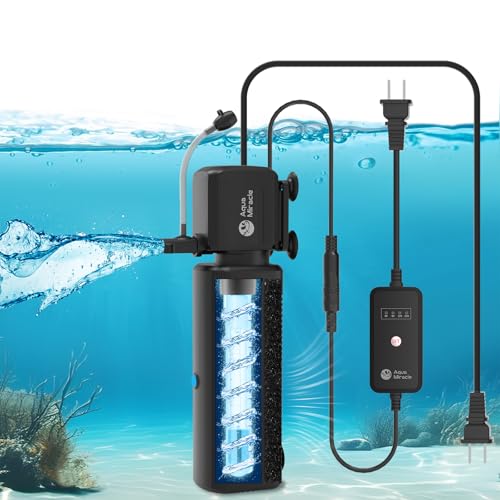
Engineered for 10–30 gallon tanks, this AquaMiracle unit provides 6W UV treatment with a max flow around 130 GPH. It combines a filter sponge with a UV lamp and a timer, supporting three operational modes. The dual-mode setup (Aeration and Rainfall) enhances water movement and oxygenation, contributing to a healthier aquarium environment and helping to maintain water clarity by targeting green water and microbial growth.
Best for: hobbyists wanting a compact, all-in-one UV and filtration solution with adjustable flow and timer control. Better for smaller tanks where plant and fish balance is a priority. Caution: timer controls only the UV light; plan your schedule to keep both filter and light aligned with your tank’s needs.
Buying Guide: Key Purchase Considerations
- Tank size and bioload: Ensure the unit is rated for 10–45 gallons and can handle your fish load. Overcrowded tanks require higher-capacity filtration in addition to UV.
- UV wavelength and exposure: Most devices use 254 nm UV light to target algae and bacteria. Consider safety features such as protective shields and proper enclosure to protect eyes and skin.
- Integration vs. standalone: Internal filters with UV may save space and simplify setup, but use aquariums with open space to allow proper water movement.
- Timer and control: A timer for the UV lamp helps maintain consistent water quality while saving energy. Separate switches for pump and light offer flexible operation.
- Maintenance: Look for units with accessible filter media and simple cleaning routines. Sponge media traps debris to keep water clear and lights effective.
- Safety considerations: Do not expose skin or eyes to UV light. Do not place UV lamps in direct contact with tank inhabitants, and ensure correct immersion depth and electrical safety.
FAQ
- Q: Do UV sterilizers kill all algae in a tank? A: UV treatment reduces free-floating algae and microorganisms but is most effective when paired with good filtration and water changes.
- Q: Can I use UV sterilizers in saltwater tanks? A: Some units support both freshwater and saltwater; verify compatibility and power settings for your setup.
- Q: How long should the UV light stay on each day? A: Timers commonly offer cycles from a few hours up to 24 hours, depending on water quality needs.
- Q: Will UV sterilizers affect beneficial bacteria? A: UV exposure mainly targets free-floating bacteria; beneficial bacteria in biofilters are typically protected within the filtration media.
- Q: Is an external UV sterilizer better than an internal one? A: External units may offer higher capacity, but internal units save space and simplify installation for compact tanks.
- Q: How soon can I see clearer water after installation? A: Water clarity often improves within 3–7 days, depending on the starting water quality and tank maintenance.