Answering the need for reliable, low-maintenance fish feeding, solar powered feeders keep ponds and aquariums fed on schedule even during power outages or for long trips. This guide highlights five top options that balance solar, battery, and AC options with user-friendly programming. Best for busy fish keepers, large ponds, or locations with sunny days, these feeders help prevent overfeeding and water clouding while offering flexible power choices.
| Product | Power Options | Best For |
|---|---|---|
| Dehyteco Solar Automatic Fish Feeder | Solar + Battery + AC | Large ponds, long vacations |
| Pond Logic The Pond Guy KoiGrower | Solar, Battery, AC | Active koi and multiple-tish ponds |
| Proshine Automatic Fish Feeder (2.8L) | Solar + Battery + AC | Outdoor or indoor use, animal-proof |
| Proshine Automatic Fish Feeder (1.5L) | Solar + Battery + AC | Smaller or medium tanks, versatility |
| Petbank Automatic Fish Feeder | USB Rechargeable | Home aquariums, precise portioning |
Dehyteco Solar Automatic Fish Feeder for Pond
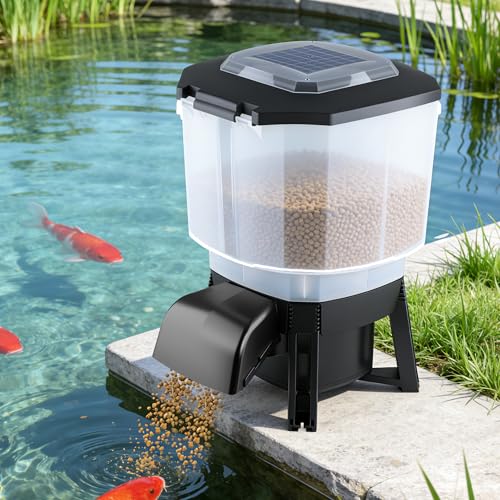
Best for large ponds and busy keepers, this feeder combines solar power with battery backup and an AC recharger. It can feed 3–10 mm pellets, storing up to 23 liters to reduce refills during vacations or extended travel. The programmable timer supports multiple daily feedings with adjustable portions to match fish size, age, and stocking density. It is designed to minimize clouding by avoiding overfeeding. Setup is straightforward on flat surfaces, boards, or fixed locations using the included insertion bar.
Who it’s for: big ponds with many fish or owners away for weeks. Why chosen: the dual power setup ensures continuous operation regardless of sunlight or outages. Limitation: large pellets beyond 3–10 mm may not feed evenly if mis-sized for the container.
Pond Logic The Pond Guy KoiGrower Automatic Pond Feeder

Best for koi ponds or mixed goldfish environments, this feeder offers continuous power from solar, AC, and battery. The auto-timed system supports consistent meal times, essential for larger koi populations. It’s easy to install and program, making daily feeding predictable even when you’re away. The ability to tailor schedules helps prevent leftover food and wasted feed.
Who it’s for: koi-focused ponds and multi-species tanks. Why chosen: reliable multi-source power ensures resilience. Limitation: setup and programming may require a bit more attention to maximize scheduling for very large flocks.
Proshine Automatic Fish Feeder for Pond (2.8L) Solar

Best for outdoor or indoor use, this Proshine model offers a 2.8L capacity with 3-in-1 power: solar, rechargeable battery, or dry batteries. It includes power-off memory so after a power interruption your set feeding program resumes automatically. The design uses rugged ABS and PC materials with a waterproof seal to deter moisture and small animals, reducing feed loss on open patios or ponds.
Who it’s for: outdoor ponds with variable sun exposure and households seeking robust, long-term operation. Why chosen: flexible power sources and durable construction support long seasons of use. Limitation: several users note a careful balance of portion size is needed to prevent overfeeding in multi-species setups.
Proshine Automatic Fish Feeder for Pond (1.5L) Solar

Best for smaller ponds or indoor setups, this 1.5L Proshine feeder uses solar, battery, and AC power to ensure reliability. It supports customizable feeding times and portions with a standard 10 g per serving, and includes a portion-reducing clip for precision. The enclosure and materials emphasize longevity and water resistance for year-round use.
Who it’s for: small to mid-size ponds or indoor tanks where space is limited. Why chosen: compact capacity paired with the same flexible power options as larger models. Limitation: smaller capacity requires more frequent refills if feeding multiple times daily.
Petbank Automatic Fish Feeder for Aquarium

Best for home aquariums requiring precise meal portions, this moisture-proof feeder delivers up to 16 grids of feeding options, equating to about 15 individual meals. It supports two installation methods—adjustable clamp base or suction cup—so it fits a range of tank shapes. The fully sealed design keeps food dry and fresh, suitable for pellets, flakes, and powders, though not ideal for shrimp.
Who it’s for: meticulous hobbyists managing multiple small meals per day in a home tank. Why chosen: high feeding accuracy and moisture resistance in a compact form. Limitation: not suited for larger flakes or non-pellet foods; avoid use with shrimps.
Buying Guide
- Power reliability: Look for 3-in-1 options (solar, battery, AC) for resilience against weather changes and power outages. If solar is inconsistent, a backup power method is essential.
- Capacity vs. feeding frequency: Choose capacity that matches your pond size and scheduled meals per day. Larger ponds benefit from bigger tanks and longer recharge cycles.
- Water safety and feed type: Ensure the feeder supports the pellet sizes you use and has moisture protection to prevent clumping. Durable seals reduce moisture ingress and food spoilage.
- Placement and ease of use: Consider installation options (flat surface, board mounting, or mounting to a structure). Easy-to-program interfaces reduce setup time and mistakes.
- Durability and enclosure: Outdoor feeders should withstand sun, rain, and animals. Look for rugged materials (ABS/PC) and waterproof seating.
- Maintenance: Check how easy it is to refill, clean, and inspect the feed chute and hopper to prevent jams and mold growth.
Frequently Asked Questions
- What is the main advantage of solar-powered fish feeders?
They provide autonomous operation with renewable energy, reducing the need for frequent manual feeding during extended trips. - Can these feeders feed different pellet sizes?
Most models support standard koi or pond pellets; verify capacity and feed size in product specs before purchase. - Do these feeders require internet or app control?
Most listed feeders operate with physical program controls; some may offer basic LCD displays or timers without Wi-Fi. - Are solar feeders suitable for indoor tanks?
Some models support indoor use with battery or AC power, but solar is typically more relevant for outdoor settings. - What maintenance is needed for solar feeders?
Regularly check battery health, clean the feed chute, ensure the solar panel is unobstructed, and verify schedule accuracy. - How do I prevent overfeeding?
Use the adjustable portion controls, schedule multiple small feedings, and monitor water clarity to fine-tune portions.