Searching for an aquarium sponge filter kit? This guide highlights five reliable kits that are well-suited for small to mid-size tanks. Each option emphasizes biological and mechanical filtration, ease of use, and quiet operation. Best for hobbyists setting up new nano tanks, breeders, or anyone seeking gentle, low-maintenance filtration. The following picks balance compact design with effective filtration, helping maintain clear water and healthier fish. A quick summary table follows to compare core details at a glance.
| Product | Brand | Best For |
|---|---|---|
| Pawfly Aquarium Air Pump with Nano Bio Sponge Filter Kit | Pawfly | 3-10 gallon tanks; beginners who want a compact complete kit |
| Pawfly Mini Aquarium Air Pump 15 GPH | Pawfly | 3-20 gallon tanks; ultra-quiet, small spaces |
| Uniclife Aquarium Air Pump Adjustable 4 LPM | Pawfly | Up to 100 gallons; versatile multi-tank use |
| Dual Outlet Aquarium Air Pump Kit (2 Sponge Filters etc.) | Finaqua | 5–155 gallon tanks; larger setups needing multiple filters |
| Pawfly Nano Aquarium Air Pump with Mini Sponge Filter | Pawfly | 1–15 gallon nano tanks; whisper-quiet operation |
Pawfly Aquarium Air Pump with Nano Bio Sponge Filter Kit
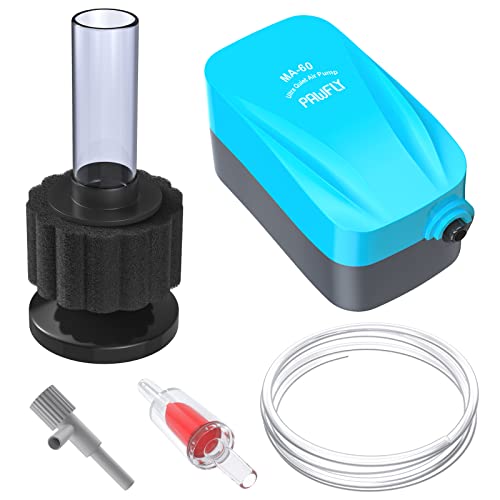
Best for small tanks and beginners. Driven by a 40 GPH air pump, the sponge filter (1.5″ D x 3″ H) delivers dense bubbles that boost oxygen levels and trap impurities. The adjustable air flow lets you tailor aeration to your tank needs. The compact pump (3.3″ L x 1.8″ W x 1.6″ H) fits 3–10 gallon setups, promoting healthy fish and plants with minimal footprint. Consider this kit if you want an all-in-one, easy-install filtration solution.
Limitations: The kit’s performance scales with tank size; very large tanks may require additional filtration power or extra sponge units.
Pawfly Mini Aquarium Air Pump 15 GPH with Bracket and Filter

Better for nano tanks and tight spaces. This 15 GPH pump operates with a sturdy bracket and wall clip, offering steady output (max flow 15 GPH) and low noise (less than 35 dB). It’s ideal for 3–20 gallon tanks or DWC buckets where space is at a premium. Choose this if you need a compact, quiet option that still supports decent aeration, especially in bedrooms or offices.
Limitation: Lower flow compared with larger pumps, so not ideal for heavily stocked or large-volume tanks.
Uniclife Aquarium Air Pump Adjustable 4 LPM

Versatile choice for mid-to-large setups. This adjustable dual-outlet pump supports tanks up to 100 gallons and offers a knob-controlled flow rate. Its 4 W power rating yields 4 LPM with a modest pressure of 0.016 MPa. Best for hobbyists managing multiple small tanks or needing reliable aeration across a larger habitat. The two outlets enable running two sponge filters or air stones simultaneously.
Caution: Ensure the outlet configuration matches your planned sponge filter layout to avoid restricted flow.
Dual Outlet Aquarium Air Pump Kit (2 Sponge Filters)

Best for larger or breeding setups. This dual-outlet kit powers two sponge filters or air stones, enhancing oxygen circulation across multiple filtration zones. It includes two sponge filters, two air stones, check valves, tubing, and connectors for a ready-to-assemble system. Choose this when you need scalable filtration for tanks from 5 to 155 gallons and want a straightforward, all-in-one solution.
Limitation: In very quiet rooms, multiple outlets may still produce noticeable hum; consider placement away from sleeping areas if ultra-low noise is required.
Pawfly Nano Aquarium Air Pump With Mini Sponge Filter

Best for ultra-small tanks. This nano air pump (1.3 W) delivers gentle aeration for 1–15 gallon tanks. It includes a mini sponge filter, air hose, airstone, and check valve, with an ultra-quiet operation around 30 dB. The compact size (2″ L x 2″ W x 0.7″ H) makes it ideal for desktops, small apartments, or nano setups where space is at a premium.
Limitation: Extremely small tanks may require careful filtration balancing; the kit is not designed for larger volumes.
Buying Guide: Key Considerations for Aquarium Sponge Filter Kits
- Tank size and filtration needs: Match pump flow rate (GPH or LPM) to tank volume. Larger aquariums require higher flow or additional sponge filters.
- Filtration style: Sponge filters provide mechanical and biological filtration. Consider kits that pair sponges with bio media for enhanced bacteria colonization.
- Noise and placement: If the setup will be near living areas, choose quiet models and consider placement to minimize vibrations.
- Upgrade potential: Some kits allow adding more sponge filters or stones; choose systems that scale with your aquarium as it grows.
- Maintenance: Look for replaceable sponges and accessible media. Easy cleaning reduces downtime and keeps water clear.
- Ease of install: All-in-one kits with brackets, tubing, check valves, and connectors simplify setup, especially for beginners.
Frequently Asked Questions
- What is a sponge filter kit best for?
– They are ideal for small to mid-sized freshwater tanks, breeding setups, and nano tanks where gentle, biological filtration is beneficial and water flow is moderate. - Do sponge filters require a separate air pump?
– Yes. Most sponge filter kits rely on an air pump to drive airflow through the sponge, creating filtration and oxygenation. - Can sponge filters handle shrimp or fry tanks?
– Many sponge filters are safe for shrimp and fry because their gentle flow reduces the risk of being sucked into intakes. - Are dual-outlet kits worth it for larger tanks?
– Yes, dual outlets help distribute aeration and filtration across larger volumes, improving overall oxygenation and water movement. - How often should sponge media be cleaned or replaced?
– Regular cleaning every few weeks is typical; replace sponges when they show excessive wear or reduced filtration efficiency. - Can I mix brands in a single setup?
– It’s possible, but ensure compatibility of valves, tubing, and airflow to avoid mismatched performance.