Maintaining stable pH and water quality is essential for the health of fish, corals, and planted tanks. A reliable pH monitor helps you track acidity, temperature, and related water parameters so you can act quickly when conditions drift. Below is a curated selection of high-accuracy, user-friendly devices designed for aquariums, hydroponics, and other water-based setups. Each choice balances ease of use, calibration flexibility, and real-time monitoring to support healthy aquatic environments.
Summary of selected products
- Digital Combo pH & Temperature Meter, Aquarium Thermometer pH Monitor with Automatic Calibration Function for Fish Tank Hydroponics Aquaculture Laboratory — Gain Express
- VIVOSUN Digital pH Meter, 0.01pH High Accuracy Pen Type pH Tester for Hydroponics, Household Drinking, Pool and Aquarium — VIVOSUN
- EZTOCH pH EC Continuous Monitor for Hydroponic, 6 in 1 WiFi EC PPM pH Meter — EZTOCH
- 2-in-1 Combo pH & Temperature Meter Water Quality Tester Replaceable BNC pH Electrode — DANOPLUS
- Monitor pH 4.5-9.5 Test KIT (400 Tests) — Generic
Digital Combo pH & Temperature Meter by Gain Express

The Gain Express unit integrates pH and temperature sensing with a permanent temperature probe and a replaceable pH probe for cost-effective maintenance. It covers a pH range from 0.0 to 14.0 with ±0.1 accuracy and 0.01 resolution. This device supports up to three-point pH calibration (pH 7.0, 4.01, and 10.01) and features automatic buffer recognition to minimize calibration errors. Automatic Temperature Compensation (ATC) ensures stable measurements across temperature fluctuations common in fish tanks and hydroponic systems. The device is suited for aquariums, hydroponics, aquaculture labs, and general water testing.
VIVOSUN Digital pH Meter

The VIVOSUN pH meter is designed for both home and professional use, with a focus on precise 0.01 pH accuracy. It features a readable LCD screen, backlighting for low-light scenarios, and a pocket-sized, lightweight form factor. The device is suitable for water in residential settings, pools, spas, aquaculture, hydroponics, and laboratories. Its calibration process emphasizes speed and accuracy, helping keep pH levels stable in sensitive ecosystems like reef tanks or planted aquariums.
EZTOCH 6-in-1 pH EC Continuous Monitor
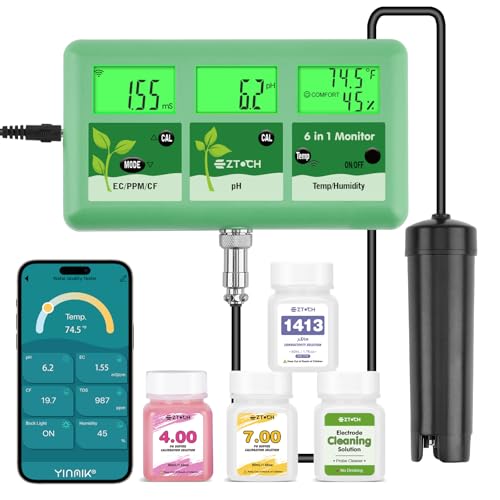
EZTOCH consolidates pH, EC, PPM, temperature, and humidity monitoring into a single WiFi-enabled device. It supports dual TDS modes (ppm500 and ppm700) and multiple measurement units (mS, CF), making it a versatile tool for hydroponics and aquaculture. The real-time Tuya app integration provides alerts, historical data, and shareable reports. This makes it ideal for growers who need consistent, proactive control over water quality in DWC systems, aeroponics, and aquarium setups. Data-driven decisions are easier thanks to continuous monitoring and remote access.
2-in-1 Combo pH & Temperature Meter by DANOPLUS

This DANOPLUS model combines a two-in-one design with a replaceable BNC electrode and a fixed temperature probe. It measures 0.00-14.00 pH and 0-55°C with automatic temperature compensation (ATC) to ensure accurate pH readings despite temperature changes. It is suitable for educational use, professional water testing, aquariums, hydroponics, and laboratory analyses where accurate, repeatable results are required. The separate electrode design minimizes contamination and makes maintenance straightforward.
Monitor pH 4.5-9.5 Test Kit (400 Tests)

This test kit provides a practical, consumable option for ongoing pH monitoring across multiple tanks or systems. It covers a pH range from 4.5 to 9.5 in 0.5 intervals, which is suitable for many freshwater and marine setups where precise digital meters are not strictly necessary. It’s particularly useful for educators, hobbyists, or facilities requiring routine spot checks rather than continuous digital logging. Results are quick and easy to interpret, helping users track trends over time.
Buying decisions often hinge on calibration needs, data logging, and the extent of automation. The five options above offer a spectrum from simple, reliable handheld meters to integrated, WiFi-enabled systems that push alerts and historical data to a phone or cloud. When choosing, consider tank size, bioload, and whether you need remote monitoring for vacation cover or multi-tank management. Calibratability, probe durability, and maintenance costs (such as replaceable electrodes) are important long-term factors to evaluate.
Buying Guide
- Calibration flexibility: Look for meters offering multiple calibration points (e.g., pH 4, 7, and 10) and automatic buffer recognition to reduce human error.
- Measurement range and resolution: Instruments should cover typical aquarium pH ranges (roughly 6.5–8.5 for many freshwater and 7.8–8.5 for some marine systems) with high resolution (0.01 pH) for precise control.
- Temperature compensation: ATC or automatic temperature compensation minimizes drift due to water temperature changes, a common occurrence in tanks and hydroponic setups.
- Probe design and maintenance: Replaceable or durable probes extend device life. Separate electrodes or integrated probes affect maintenance frequency and contamination risk.
- Display and readability: Backlit LCD screens and color displays help readers quickly interpret pH and temperature, especially in dim tanks or labs.
- Connectivity and monitoring: WiFi-enabled devices allow remote alerts, data logging, and cloud history. Apps that support notifications and trend analysis add value for ongoing maintenance.
- Suitability for multi-tank or multi-parameter monitoring: If managing several tanks or hydroponic bays, multi-parameter devices or 5-in-1 meters simplify setup and reduce gear clutter.
- Durability and water resistance: Look for IP-rated housings or robust probes designed for regular immersion, especially in marine or reef environments where salinity can affect readings.
- Cost of ownership: Consider calibration solutions, spare probes, and replacement parts as ongoing costs in your decision.
- User experience: A straightforward calibration process, clear readings, and reliable one-touch calibration features improve consistency over time.
In summary, the right pH monitor depends on your needs: a precise, easy-to-calibrate meter for hobbyist aquariums; a rugged, integrated system for commercial setups; or a WiFi-connected monitor that keeps you informed remotely. This selection emphasizes accuracy, ease of use, and long-term maintenance to support stable aquatic environments.